


Page 339 - First Aid for the USMLE Step 1 2020, Thirtieth edition [MedicalBooksVN.com]_Neat
P. 339
CARDIOvASCuLAR  ``CARdIOvASCulAR—PHYSIOlOGY     CARDIOvASCuLAR  ``CARdIOvASCulAR—PHYSIOlOGY           SECTION III      295


                  ECG tracings
                    RHYTHM           dESCRIPTION                                             EXAMPlE
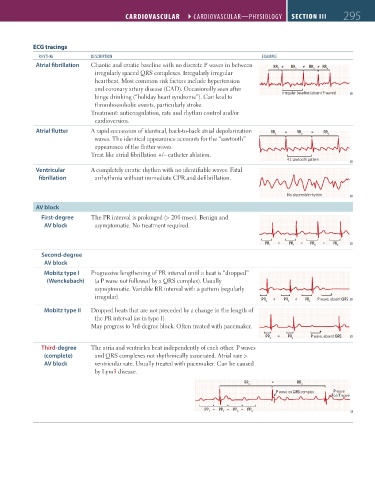
                   Atrial fibrillation  Chaotic and erratic baseline with no discrete P waves in between   RR ≠  RR  ≠ RR  ≠ RR
                                       irregularly spaced QRS complexes. Irregularly irregular    1     2     3   4
                                       heartbeat. Most common risk factors include hypertension
                                       and coronary artery disease (CAD). Occasionally seen after
                                       binge drinking (“holiday heart syndrome”). Can lead to       Irregular baseline (absent P waves)
                                       thromboembolic events, particularly stroke.
                                     Treatment: anticoagulation, rate and rhythm control and/or
                                       cardioversion.
                   Atrial flutter    A rapid succession of identical, back-to-back atrial depolarization   RR  =  RR  =  RR
                                       waves. The identical appearance accounts for the “sawtooth”   1    2        3
                                       appearance of the flutter waves.
                                     Treat like atrial fibrillation +/– catheter ablation.
                                                                                                     4:1 sawtooth pattern
                   Ventricular       A completely erratic rhythm with no identifiable waves. Fatal
                    fibrillation       arrhythmia without immediate CPR and defibrillation.

                                                                                                     No discernible rhythm

                   AV block
                     First-degree    The PR interval is prolonged (> 200 msec). Benign and
                      AV block         asymptomatic. No treatment required.


                                                                                              PR 1  =  PR 2  =  PR 3  =  PR 4
                     Second-degree
                      AV block
                      Mobitz type I   Progressive lengthening of PR interval until a beat is “dropped”
                       (Wenckebach)    (a P wave not followed by a QRS complex). Usually
                                       asymptomatic. Variable RR interval with a pattern (regularly
                                       irregular).
                                                                                     PR
                                                                                       1  <  PR 1  <  PR 2  <  PR 3  P wave, absent QRS
                      Mobitz type II  Dropped beats that are not preceded by a change in the length of
                                       the PR interval (as in type I).
                                     May progress to 3rd-degree block. Often treated with pacemaker.
                                                                                      PR 1  =  PR 1  =  PR 2  P wave, absent QRS
                     Third-degree    The atria and ventricles beat independently of each other. P waves
                      (complete)       and QRS complexes not rhythmically associated. Atrial rate >
                      AV block         ventricular rate. Usually treated with pacemaker. Can be caused
                                       by Lym3 disease.

                                                                                       RR 1     =        RR 2
                                                                                                  P wave on QRS complex  P wave
                                                                                                                    on T wave
                                                                          PP = PP 2  = PP 3  = PP 4
                                                                            1


          FAS1_2019_07-Cardio.indd   295                                                                                11/7/19   4:24 PM

