


Page 344 - First Aid for the USMLE Step 1 2020, Thirtieth edition [MedicalBooksVN.com]_Neat
P. 344
300 SECTION III CARDIOvASCuLAR ``CARdIOvASCulAR—PATHOlOGY CARDIOvASCuLAR ``CARdIOvASCulAR—PATHOlOGY
Congenital cardiac dISORdER dEFECT
defect associations Alcohol exposure in utero (fetal alcohol VSD, PDA, ASD, tetralogy of Fallot
syndrome)
Congenital rubella PDA, pulmonary artery stenosis, septal defects
Down syndrome AV septal defect (endocardial cushion defect),
VSD, ASD
Infant of diabetic mother Transposition of great vessels, VSD
Marfan syndrome MVP, thoracic aortic aneurysm and dissection,
aortic regurgitation
Prenatal lithium exposure Ebstein anomaly
Turner syndrome Bicuspid aortic valve, coarctation of aorta
Williams syndrome Supravalvular aortic stenosis
22q11 syndromes Truncus arteriosus, tetralogy of Fallot
Hypertension Persistent systolic BP ≥ 130 mm Hg and/or diastolic BP ≥ 80 mm Hg.
RISK FACTORS age, obesity, diabetes, physical inactivity, excess salt intake, excess alcohol intake, cigarette
smoking, family history; African American > Caucasian > Asian.
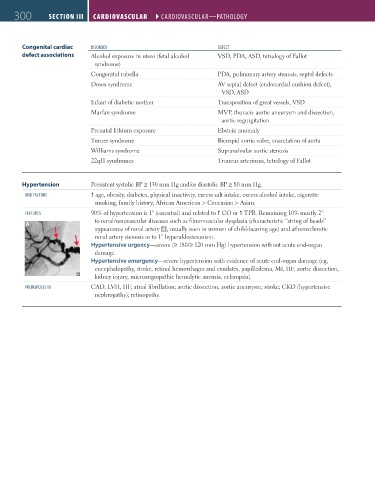
FEATuRES 90% of hypertension is 1° (essential) and related to CO or TPR. Remaining 10% mostly 2°
to renal/renovascular diseases such as fibromuscular dysplasia (characteristic “string of beads”
A
appearance of renal artery A , usually seen in women of child-bearing age) and atherosclerotic
renal artery stenosis or to 1° hyperaldosteronism.
Hypertensive urgency—severe (≥ 180/≥ 120 mm Hg) hypertension without acute end-organ
damage.
Hypertensive emergency—severe hypertension with evidence of acute end-organ damage (eg,
encephalopathy, stroke, retinal hemorrhages and exudates, papilledema, MI, HF, aortic dissection,
kidney injury, microangiopathic hemolytic anemia, eclampsia).
PREdISPOSES TO CAD, LVH, HF, atrial fibrillation; aortic dissection, aortic aneurysm; stroke; CKD (hypertensive
nephropathy); retinopathy.
FAS1_2019_07-Cardio.indd 300 11/7/19 4:24 PM

