


Page 388 - First Aid for the USMLE Step 1 2020, Thirtieth edition [MedicalBooksVN.com]_Neat
P. 388
344 SEcTion iii EndocrinE ` endocrine—PAthology EndocrinE ` endocrine—PAthology
Hypoparathyroidism Due to injury to parathyroid glands or their blood supply (usually during surgery), autoimmune
A destruction, or DiGeorge syndrome. Findings: tetany, hypocalcemia, hyperphosphatemia.
Chvostek sign—tapping of facial nerve (tap the Cheek) contraction of facial muscles.
Trousseau sign—occlusion of brachial artery with BP cuff (cuff the Triceps) carpal spasm.
Pseudohypoparathyroidism type 1A—autosomal dominant, maternally transmitted mutations
(imprinted GNAS gene). GNAS1-inactivating mutation (coupled to PTH receptor) that encodes
the G s protein α subunit inactivation of adenylate cyclase when PTH binds to its receptor
end-organ resistance (kidney and bone) to PTH.
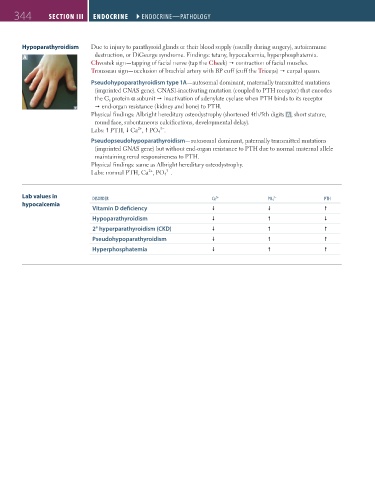
Physical findings: Albright hereditary osteodystrophy (shortened 4th/5th digits A , short stature,
round face, subcutaneous calcifications, developmental delay).
3–
2+
Labs: PTH, Ca , PO 4 .
Pseudopseudohypoparathyroidism—autosomal dominant, paternally transmitted mutations
(imprinted GNAS gene) but without end-organ resistance to PTH due to normal maternal allele
maintaining renal responsiveness to PTH.
Physical findings: same as Albright hereditary osteodystrophy.
3–
2+
Labs: normal PTH, Ca , PO 4 .
Lab values in disorder ca 2+ 3– Pth
hypocalcemia Po 4
Vitamin D deficiency
Hypoparathyroidism
2° hyperparathyroidism (CKD)
Pseudohypoparathyroidism
Hyperphosphatemia
FAS1_2019_08-Endocrine.indd 344 11/7/19 4:30 PM

