


Page 431 - First Aid for the USMLE Step 1 2020, Thirtieth edition [MedicalBooksVN.com]_Neat
P. 431
Gastrointestinal ` gastrointestinal—PatHology Gastrointestinal ` gastrointestinal—PatHology seCtion iii 387
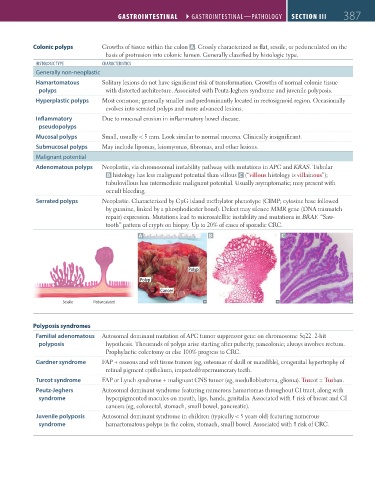
Colonic polyps Growths of tissue within the colon A . Grossly characterized as flat, sessile, or pedunculated on the
basis of protrusion into colonic lumen. Generally classified by histologic type.
HistologiC tyPe CHaraCteristiCs
Generally non-neoplastic
Hamartomatous Solitary lesions do not have significant risk of transformation. Growths of normal colonic tissue
polyps with distorted architecture. Associated with Peutz-Jeghers syndrome and juvenile polyposis.
Hyperplastic polyps Most common; generally smaller and predominantly located in rectosigmoid region. Occasionally
evolves into serrated polyps and more advanced lesions.
Inflammatory Due to mucosal erosion in inflammatory bowel disease.
pseudopolyps
Mucosal polyps Small, usually < 5 mm. Look similar to normal mucosa. Clinically insignificant.
Submucosal polyps May include lipomas, leiomyomas, fibromas, and other lesions.
Malignant potential
Adenomatous polyps Neoplastic, via chromosomal instability pathway with mutations in APC and KRAS. Tubular
B histology has less malignant potential than villous C (“villous histology is villainous”);
tubulovillous has intermediate malignant potential. Usually asymptomatic; may present with
occult bleeding.
Serrated polyps Neoplastic. Characterized by CpG island methylator phenotype (CIMP; cytosine base followed
by guanine, linked by a phosphodiester bond). Defect may silence MMR gene (DNA mismatch
repair) expression. Mutations lead to microsatellite instability and mutations in BRAF. “Saw-
tooth” pattern of crypts on biopsy. Up to 20% of cases of sporadic CRC.
A B C
Polyp
Polyp
Cancer
Sessile Pedunculated
Polyposis syndromes
Familial adenomatous Autosomal dominant mutation of APC tumor suppressor gene on chromosome 5q22. 2-hit
polyposis hypothesis. Thousands of polyps arise starting after puberty; pancolonic; always involves rectum.
Prophylactic colectomy or else 100% progress to CRC.
Gardner syndrome FAP + osseous and soft tissue tumors (eg, osteomas of skull or mandible), congenital hypertrophy of
retinal pigment epithelium, impacted/supernumerary teeth.
Turcot syndrome FAP or Lynch syndrome + malignant CNS tumor (eg, medulloblastoma, glioma). Turcot = Turban.
Peutz-Jeghers Autosomal dominant syndrome featuring numerous hamartomas throughout GI tract, along with
syndrome hyperpigmented macules on mouth, lips, hands, genitalia. Associated with risk of breast and GI
cancers (eg, colorectal, stomach, small bowel, pancreatic).
Juvenile polyposis Autosomal dominant syndrome in children (typically < 5 years old) featuring numerous
syndrome hamartomatous polyps in the colon, stomach, small bowel. Associated with risk of CRC.
FAS1_2019_09-Gastrointestinal.indd 387 11/7/19 4:42 PM

