Page 635 - First Aid for the USMLE Step 1 2020, Thirtieth edition [MedicalBooksVN.com]_Neat
P. 635
Renal  ` RENAL—PhysioLogy                                            Renal  ` RENAL—PhysioLogy        SeCTIOn III      591


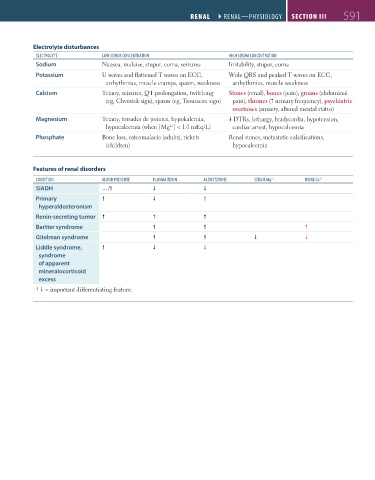
                  Electrolyte disturbances
                   ELECtRoLytE           LoW sERUm CoNCENtRAtioN                  high sERUm CoNCENtRAtioN
                   Sodium                Nausea, malaise, stupor, coma, seizures  Irritability, stupor, coma
                   Potassium             U waves and flattened T waves on ECG,    Wide QRS and peaked T waves on ECG,
                                          arrhythmias, muscle cramps, spasm, weakness  arrhythmias, muscle weakness
                   Calcium               Tetany, seizures, QT prolongation, twitching   Stones (renal), bones (pain), groans (abdominal
                                          (eg, Chvostek sign), spasm (eg, Trousseau sign)  pain), thrones ( urinary frequency), psychiatric
                                                                                   overtones (anxiety, altered mental status)
                   Magnesium             Tetany, torsades de pointes, hypokalemia,    DTRs, lethargy, bradycardia, hypotension,
                                          hypocalcemia (when [Mg ] < 1.0 mEq/L)     cardiac arrest, hypocalcemia
                                                               2+
                   Phosphate             Bone loss, osteomalacia (adults), rickets   Renal stones, metastatic calcifications,
                                          (children)                                hypocalcemia


                  Features of renal disorders
                   CoNDitioN             bLooD PREssURE  PLAsmA RENiN     ALDostERoNE      sERUm mg 2+     URiNE Ca 2+
                   SIADH                 —/                             
                   Primary                                              
                    hyperaldosteronism

                   Renin-secreting tumor                                
                   Bartter syndrome                                                                      
                   Gitelman syndrome                                                                    
                   Liddle syndrome,                                     
                    syndrome
                    of apparent
                    mineralocorticoid
                    excess
                     = important differentiating feature.


          FAS1_2019_14-Renal.indd   591                                                                                 11/7/19   5:42 PM
   630   631   632   633   634   635   636   637   638   639   640