


Page 641 - First Aid for the USMLE Step 1 2020, Thirtieth edition [MedicalBooksVN.com]_Neat
P. 641
Renal ` RENAL—PAthoLogy Renal ` RENAL—PAthoLogy SeCTIOn III 597
Nephrotic syndrome NephrOtic syndrome—massive prOteinuria (> 3.5 g/day)
Minimal change Also known as lipoid nephrosis. Most common cause of nephrotic syndrome in children.
disease Often 1° (Idiopathic) and may be triggered by recent Infection, Immunization, Immune stimulus
(4 I’s of MCD). Rarely, may be 2° to lymphoma (eg, cytokine-mediated damage).
1° disease has excellent response to corticosteroids.
LM—Normal glomeruli (lipid may be seen in PCT cells)
IF—⊝
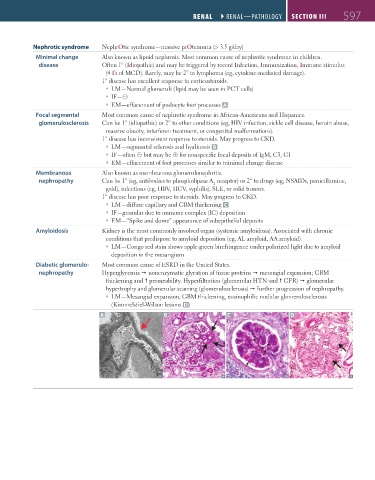
EM—effacement of podocyte foot processes A
Focal segmental Most common cause of nephrotic syndrome in African-Americans and Hispanics.
glomerulosclerosis Can be 1° (idiopathic) or 2° to other conditions (eg, HIV infection, sickle cell disease, heroin abuse,
massive obesity, interferon treatment, or congenital malformations).
1° disease has inconsistent response to steroids. May progress to CKD.
LM—segmental sclerosis and hyalinosis B
IF—often ⊝ but may be ⊕ for nonspecific focal deposits of IgM, C3, C1
EM—effacement of foot processes similar to minimal change disease
Membranous Also known as membranous glomerulonephritis.
nephropathy Can be 1° (eg, antibodies to phospholipase A receptor) or 2° to drugs (eg, NSAIDs, penicillamine,
2
gold), infections (eg, HBV, HCV, syphilis), SLE, or solid tumors.
1° disease has poor response to steroids. May progress to CKD.
LM—diffuse capillary and GBM thickening C
IF—granular due to immune complex (IC) deposition
EM—“Spike and dome” appearance of subepithelial deposits
Amyloidosis Kidney is the most commonly involved organ (systemic amyloidosis). Associated with chronic
conditions that predispose to amyloid deposition (eg, AL amyloid, AA amyloid).
LM—Congo red stain shows apple-green birefringence under polarized light due to amyloid
deposition in the mesangium
Diabet ic glomerulo- Most common cause of ESRD in the United States.
nephropathy Hyperglycemia nonenzymatic glycation of tissue proteins mesangial expansion; GBM
thickening and permeability. Hyperfiltration (glomerular HTN and GFR) glomerular
hypertrophy and glomerular scarring (glomerulosclerosis) further progression of nephropathy.
LM—Mesangial expansion, GBM thickening, eosinophilic nodular glomerulosclerosis
(Kimmelstiel-Wilson lesions D)
A B C D
FAS1_2019_14-Renal.indd 597 11/7/19 5:42 PM

