Page 642 - First Aid for the USMLE Step 1 2020, Thirtieth edition [MedicalBooksVN.com]_Neat
P. 642
598        SeCTIOn III    Renal  ` RENAL—PAthoLogy                                                                                                                                   Renal  ` RENAL—PAthoLogy


               Kidney        Can lead to severe complications such as hydronephrosis, pyelonephritis, and acute kidney injury. Obstructed
               stones         stone presents with unilateral flank tenderness, colicky pain radiating to groin, hematuria. Treat and prevent
                              by encouraging fluid intake.
                CoNtENt      PRECiPitAtEs With  X-RAy FiNDiNgs  Ct FiNDiNgs  URiNE CRystAL  NotEs
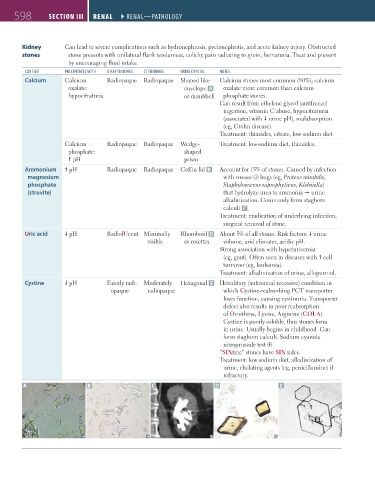
                Calcium      Calcium       Radiopaque  Radiopaque  Shaped like   Calcium stones most common (80%); calcium
                              oxalate:                              envelope  A    oxalate more common than calcium
                              hypocitraturia                        or dumbbell  phosphate stones.
                                                                               Can result from ethylene glycol (antifreeze)
                                                                                ingestion, vitamin C abuse, hypocitraturia
                                                                                (associated with  urine pH), malabsorption
                                                                                (eg, Crohn disease).
                                                                               Treatment: thiazides, citrate, low-sodium diet.
                             Calcium      Radiopaque  Radiopaque  Wedge-       Treatment: low-sodium diet, thiazides.
                              phosphate:                            shaped
                               pH                                  prism
                Ammonium      pH         Radiopaque  Radiopaque  Coffin lid  B  Account for 15% of stones. Caused by infection
                 magnesium                                                       with urease ⊕ bugs (eg, Proteus mirabilis,
                 phosphate                                                      Staphylococcus saprophyticus, Klebsiella)
                 (struvite)                                                     that hydrolyze urea to ammonia Ž urine
                                                                                alkalinization. Commonly form staghorn
                                                                                calculi  C .
                                                                               Treatment: eradication of underlying infection,
                                                                                 surgical removal of stone.
                Uric acid     pH          RadiolUcent Minimally   Rhomboid  D  About 5% of all stones. Risk factors:  urine
                                                        visible     or rosettes  volume, arid climates, acidic pH.
                                                                               Strong association with hyperuricemia
                                                                                 (eg, gout). Often seen in diseases with  cell
                                                                                 turnover (eg, leukemia).
                                                                               Treatment: alkalinization of urine, allopurinol.
                Cystine       pH          Faintly radi-  Moderately   Hexagonal  E  Hereditary (autosomal recessive) condition in
                                            opaque      radiopaque               which Cystine-reabsorbing PCT transporter
                                                                                 loses function, causing cystinuria. Transporter
                                                                                 defect also results in poor reabsorption
                                                                                 of Ornithine, Lysine, Arginine (COLA).
                                                                                 Cystine is poorly soluble, thus stones form
                                                                                 in urine. Usually begins in childhood. Can
                                                                                 form staghorn calculi. Sodium cyanide
                                                                                 nitroprusside test ⊕.
                                                                               “SIXtine” stones have SIX sides.
                                                                               Treatment: low sodium diet, alkalinization of
                                                                                urine, chelating agents (eg, penicillamine) if
                                                                                refractory.
               A                    B                    C                    D                    E


          FAS1_2019_14-Renal.indd   598                                                                                 11/7/19   5:42 PM
   637   638   639   640   641   642   643   644   645   646   647