


Page 696 - First Aid for the USMLE Step 1 2020, Thirtieth edition [MedicalBooksVN.com]_Neat
P. 696
652 SectioN iii RepRoductive ` REPRODUCTIVE—PATHOlOgy RepRoductive ` REPRODUCTIVE—PATHOlOgy
Extragonadal germ cell Arise in midline locations. In adults, most commonly in retroperitoneum, mediastinum, pineal, and
tumors suprasellar regions. In infants and young children, sacrococcygeal teratomas are most common.
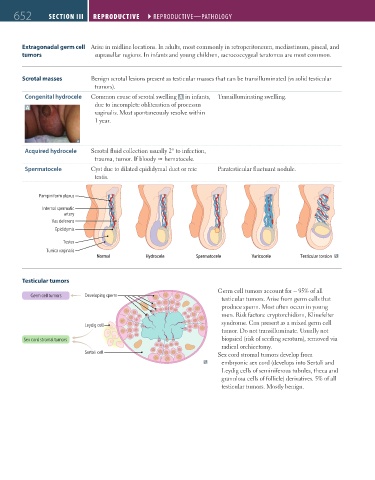
Scrotal masses Benign scrotal lesions present as testicular masses that can be transilluminated (vs solid testicular
tumors).
Congenital hydrocele Common cause of scrotal swelling A in infants, Transilluminating swelling.
A due to incomplete obliteration of processus
vaginalis. Most spontaneously resolve within
1 year.
Acquired hydrocele Scrotal fluid collection usually 2° to infection,
trauma, tumor. If bloody hematocele.
Spermatocele Cyst due to dilated epididymal duct or rete Paratesticular fluctuant nodule.
testis.
Pampiniform plexus
Internal spermatic
artery
Vas deferens
Epididymis
Testes
Tunica vaginalis
Normal Hydrocele Spermatocele Varicocele Testicular torsion
Testicular tumors
Germ cell tumors account for ∼ 95% of all
Germ cell tumors Developing sperm
testicular tumors. Arise from germ cells that
produce sperm. Most often occur in young
men. Risk factors: cryptorchidism, Klinefelter
syndrome. Can present as a mixed germ cell
Leydig cell
tumor. Do not transilluminate. Usually not
Sex cord stromal tumors biopsied (risk of seeding scrotum), removed via
radical orchiectomy.
Sertoli cell Sex cord stromal tumors develop from
embryonic sex cord (develops into Sertoli and
Leydig cells of seminiferous tubules, theca and
granulosa cells of follicle) derivatives. 5% of all
testicular tumors. Mostly benign.
FAS1_2019_15-Repro.indd 652 11/7/19 5:52 PM

