


Page 692 - First Aid for the USMLE Step 1 2020, Thirtieth edition [MedicalBooksVN.com]_Neat
P. 692
648 SectioN iii RepRoductive ` REPRODUCTIVE—PATHOlOgy RepRoductive ` REPRODUCTIVE—PATHOlOgy
Uterine conditions
Non-neoplastic uterine conditions
Adenomyosis Extension of endometrial tissue (glandular) into uterine myometrium. Caused by hyperplasia of
basal layer of endometrium. Presents with dysmenorrhea, AUB/HMB, and uniformly enlarged, soft,
globular uterus. Treatment: GnRH agonists, hysterectomy, excision of an organized adenomyoma.
Asherman syndrome Adhesions and/or fibrosis of the endometrium. Presents with fertility, recurrent pregnancy loss,
AUB, pelvic pain. Often associated with dilation and curettage of intrauterine cavity.
Endometrial Abnormal endometrial gland proliferation usually stimulated by excess estrogen. risk for
hyperplasia endometrial carcinoma (especially with nuclear atypia). Presents as postmenopausal vaginal
bleeding. risk with anovulatory cycles, hormone replacement therapy, PCOS, granulosa cell
tumors.
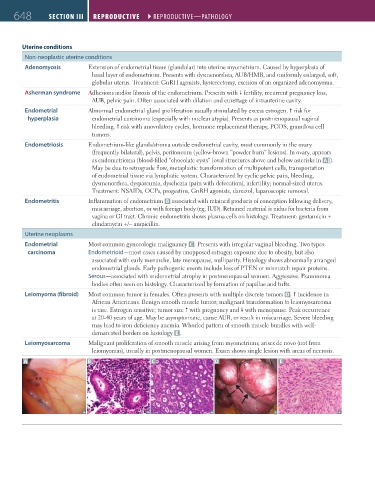
Endometriosis Endometrium-like glands/stroma outside endometrial cavity, most commonly in the ovary
(frequently bilateral), pelvis, peritoneum (yellow-brown “powder burn” lesions). In ovary, appears
as endometrioma (blood-filled “chocolate cysts” [oval structures above and below asterisks in A ]).
May be due to retrograde flow, metaplastic transformation of multipotent cells, transportation
of endometrial tissue via lymphatic system. Characterized by cyclic pelvic pain, bleeding,
dysmenorrhea, dyspareunia, dyschezia (pain with defecation), infertility; normal-sized uterus.
Treatment: NSAIDs, OCPs, progestins, GnRH agonists, danazol, laparoscopic removal.
Endometritis Inflammation of endometrium B associated with retained products of conception following delivery,
miscarriage, abortion, or with foreign body (eg, IUD). Retained material is nidus for bacteria from
vagina or GI tract. Chronic endometritis shows plasma cells on histology. Treatment: gentamicin +
clindamycin +/− ampicillin.
Uterine neoplasms
Endometrial Most common gynecologic malignancy C . Presents with irregular vaginal bleeding. Two types:
carcinoma Endometrioid—most cases caused by unopposed estrogen exposure due to obesity, but also
associated with early menarche, late menopause, nulliparity. Histology shows abnormally arranged
endometrial glands. Early pathogenic events include loss of PTEN or mismatch repair proteins.
Serous—associated with endometrial atrophy in postmenopausal women. Aggressive. Psammoma
bodies often seen on histology. Characterized by formation of papillae and tufts.
Leiomyoma (fibroid) Most common tumor in females. Often presents with multiple discrete tumors D. incidence in
African Americans. Benign smooth muscle tumor; malignant transformation to leiomyosarcoma
is rare. Estrogen sensitive; tumor size with pregnancy and with menopause. Peak occurrence
at 20-40 years of age. May be asymptomatic, cause AUB, or result in miscarriage. Severe bleeding
may lead to iron deficiency anemia. Whorled pattern of smooth muscle bundles with well-
demarcated borders on histology E .
Leiomyosarcoma Malignant proliferation of smooth muscle arising from myometrium; arises de novo (not from
leiomyomas), usually in postmenopausal women. Exam shows single lesion with areas of necrosis.
A B C D E
FAS1_2019_15-Repro.indd 648 11/7/19 5:52 PM

