


Page 695 - First Aid for the USMLE Step 1 2020, Thirtieth edition [MedicalBooksVN.com]_Neat
P. 695
RepRoductive ` REPRODUCTIVE—PATHOlOgy RepRoductive ` REPRODUCTIVE—PATHOlOgy SectioN iii 651
Penile pathology
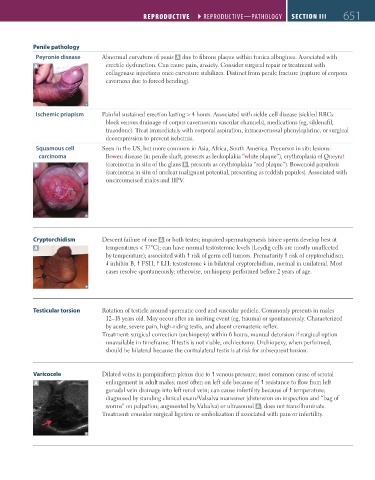
Peyronie disease Abnormal curvature of penis A due to fibrous plaque within tunica albuginea. Associated with
A erectile dysfunction. Can cause pain, anxiety. Consider surgical repair or treatment with
collagenase injections once curvature stabilizes. Distinct from penile fracture (rupture of corpora
cavernosa due to forced bending).
Ischemic priapism Painful sustained erection lasting > 4 hours. Associated with sickle cell disease (sickled RBCs
block venous drainage of corpus cavernosum vascular channels), medications (eg, sildenafil,
trazodone). Treat immediately with corporal aspiration, intracavernosal phenylephrine, or surgical
decompression to prevent ischemia.
Squamous cell Seen in the US, but more common in Asia, Africa, South America. Precursor in situ lesions:
carcinoma Bowen disease (in penile shaft, presents as leukoplakia “white plaque”), erythroplasia of Queyrat
B (carcinoma in situ of the glans B , presents as erythroplakia “red plaque”). Bowenoid papulosis
(carcinoma in situ of unclear malignant potential, presenting as reddish papules). Associated with
uncircumcised males and HPV.
Cryptorchidism Descent failure of one A or both testes; impaired spermatogenesis (since sperm develop best at
A temperatures < 37°C); can have normal testosterone levels (Leydig cells are mostly unaffected
by temperature); associated with risk of germ cell tumors. Prematurity risk of cryptorchidism.
inhibin B, FSH, LH; testosterone in bilateral cryptorchidism, normal in unilateral. Most
cases resolve spontaneously; otherwise, orchiopexy performed before 2 years of age.
Testicular torsion Rotation of testicle around spermatic cord and vascular pedicle. Commonly presents in males
12–18 years old. May occur after an inciting event (eg, trauma) or spontaneously. Characterized
by acute, severe pain, high-riding testis, and absent cremasteric reflex.
Treatment: surgical correction (orchiopexy) within 6 hours, manual detorsion if surgical option
unavailable in timeframe. If testis is not viable, orchiectomy. Orchiopexy, when performed,
should be bilateral because the contralateral testis is at risk for subsequent torsion.
Varicocele Dilated veins in pampiniform plexus due to venous pressure; most common cause of scrotal
A enlargement in adult males; most often on left side because of resistance to flow from left
gonadal vein drainage into left renal vein; can cause infertility because of temperature;
diagnosed by standing clinical exam/Valsalva maneuver (distension on inspection and “bag of
worms” on palpation; augmented by Valsalva) or ultrasound A ; does not transilluminate.
Treatment: consider surgical ligation or embolization if associated with pain or infertility.
FAS1_2019_15-Repro.indd 651 11/7/19 5:52 PM

