


Page 691 - First Aid for the USMLE Step 1 2020, Thirtieth edition [MedicalBooksVN.com]_Neat
P. 691
RepRoductive ` REPRODUCTIVE—PATHOlOgy RepRoductive ` REPRODUCTIVE—PATHOlOgy SectioN iii 647
Ovarian neoplasms (continued)
Germ cell tumors
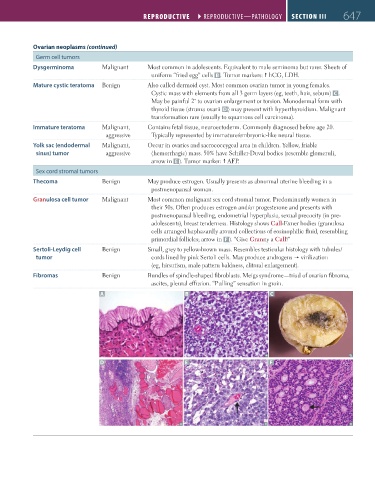
Dysgerminoma Malignant Most common in adolescents. Equivalent to male seminoma but rarer. Sheets of
uniform “fried egg” cells B . Tumor markers: hCG, LDH.
Mature cystic teratoma Benign Also called dermoid cyst. Most common ovarian tumor in young females.
Cystic mass with elements from all 3 germ layers (eg, teeth, hair, sebum) C .
May be painful 2˚ to ovarian enlargement or torsion. Monodermal form with
thyroid tissue (struma ovarii D) may present with hyperthyroidism. Malignant
transformation rare (usually to squamous cell carcinoma).
Immature teratoma Malignant, Contains fetal tissue, neuroectoderm. Commonly diagnosed before age 20.
aggressive Typically represented by immature/embryonic-like neural tissue.
Yolk sac (endodermal Malignant, Occur in ovaries and sacrococcygeal area in children. Yellow, friable
sinus) tumor aggressive (hemorrhagic) mass. 50% have Schiller-Duval bodies (resemble glomeruli,
arrow in E ). Tumor marker: AFP.
Sex cord stromal tumors
Thecoma Benign May produce estrogen. Usually presents as abnormal uterine bleeding in a
postmenopausal woman.
Granulosa cell tumor Malignant Most common malignant sex cord stromal tumor. Predominantly women in
their 50s. Often produces estrogen and/or progesterone and presents with
postmenopausal bleeding, endometrial hyperplasia, sexual precocity (in pre-
adolescents), breast tenderness. Histology shows Call-Exner bodies (granulosa
cells arranged haphazardly around collections of eosinophilic fluid, resembling
primordial follicles; arrow in F ). “Give Granny a Call!”
Sertoli-Leydig cell Benign Small, grey to yellow-brown mass. Resembles testicular histology with tubules/
tumor cords lined by pink Sertoli cells. May produce androgens virilization
(eg, hirsutism, male pattern baldness, clitoral enlargement).
Fibromas Benign Bundles of spindle-shaped fibroblasts. Meigs syndrome—triad of ovarian fibroma,
ascites, pleural effusion. “Pulling” sensation in groin.
A B C
D E F
FAS1_2019_15-Repro.indd 647 11/7/19 5:52 PM

