


Page 693 - First Aid for the USMLE Step 1 2020, Thirtieth edition [MedicalBooksVN.com]_Neat
P. 693
RepRoductive ` REPRODUCTIVE—PATHOlOgy RepRoductive ` REPRODUCTIVE—PATHOlOgy SectioN iii 649
Breast pathology
Nipple Lactiferous duct Major duct Terminal duct
lobular unit Stroma
Intraductal papilloma Fibrocystic change
Abscess/mastitis DCIS Fibroadenoma
Paget disease Phyllodes tumor
LCIS
Ductal carcinoma
Lobular carcinoma
Benign breast diseases
Fibrocystic changes Most common in premenopausal women 20-50 years old. Present with premenstrual breast pain
or lumps; often bilateral and multifocal. Nonproliferative lesions include simple cysts (fluid-filled
duct dilation, blue dome), papillary apocrine change/metaplasia, stromal fibrosis. Risk of cancer is
usually not increased. Subtypes include:
Sclerosing adenosis—acini and stromal fibrosis, associated with calcifications. Slight risk for
cancer.
Epithelial hyperplasia—cells in terminal ductal or lobular epithelium. risk of carcinoma with
atypical cells.
Inflammatory Fat necrosis—benign, usually painless, lump due to injury to breast tissue. Calcified oil cyst on
processes mammography; necrotic fat and giant cells on biopsy. Up to 50% of patients may not report trauma.
Lactational mastitis—occurs during breastfeeding, risk of bacterial infection through cracks in
nipple. S aureus is most common pathogen. Treat with antibiotics and continue breastfeeding.
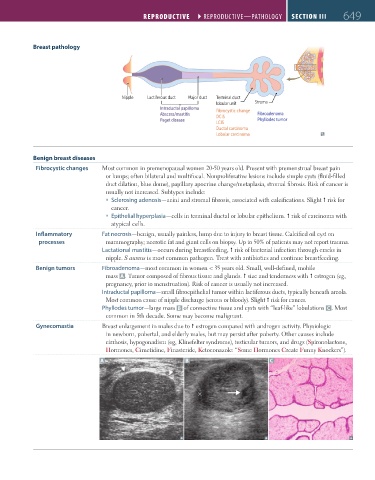
Benign tumors Fibroadenoma—most common in women < 35 years old. Small, well-defined, mobile
mass A . Tumor composed of fibrous tissue and glands. size and tenderness with estrogen (eg,
pregnancy, prior to menstruation). Risk of cancer is usually not increased.
Intraductal papilloma—small fibroepithelial tumor within lactiferous ducts, typically beneath areola.
Most common cause of nipple discharge (serous or bloody). Slight risk for cancer.
Phyllodes tumor—large mass B of connective tissue and cysts with “leaf-like” lobulations C . Most
common in 5th decade. Some may become malignant.
Gynecomastia Breast enlargement in males due to estrogen compared with androgen activity. Physiologic
in newborn, pubertal, and elderly males, but may persist after puberty. Other causes include
cirrhosis, hypogonadism (eg, Klinefelter syndrome), testicular tumors, and drugs (Spironolactone,
Hormones, Cimetidine, Finasteride, Ketoconazole: “Some Hormones Create Funny Knockers”).
A B C
FAS1_2019_15-Repro.indd 649 11/7/19 5:52 PM

