


Page 704 - First Aid for the USMLE Step 1 2020, Thirtieth edition [MedicalBooksVN.com]_Neat
P. 704
660 seCtioN iii RespiRatoRy ` RESPIRATORY—EmbRYOlOgY RespiRatoRy ` RESPIRATORY—EmbRYOlOgY
` RESPIRATORY—EmbRYOlOgY
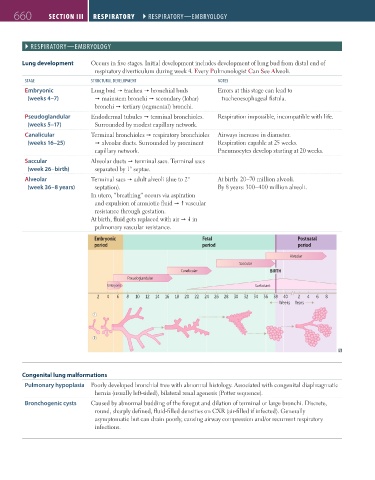
Lung development Occurs in five stages. Initial development includes development of lung bud from distal end of
respiratory diverticulum during week 4. Every Pulmonologist Can See Alveoli.
STAgE STRUCTURAl DEVElOPmENT NOTES
Embryonic Lung bud trachea bronchial buds Errors at this stage can lead to
(weeks 4–7) mainstem bronchi secondary (lobar) tracheoesophageal fistula.
bronchi tertiary (segmental) bronchi.
Pseudoglandular Endodermal tubules terminal bronchioles. Respiration impossible, incompatible with life.
(weeks 5–17) Surrounded by modest capillary network.
Canalicular Terminal bronchioles respiratory bronchioles Airways increase in diameter.
(weeks 16–25) alveolar ducts. Surrounded by prominent Respiration capable at 25 weeks.
capillary network. Pneumocytes develop starting at 20 weeks.
Saccular Alveolar ducts terminal sacs. Terminal sacs
(week 26–birth) separated by 1° septae.
Alveolar Terminal sacs adult alveoli (due to 2° At birth: 20–70 million alveoli.
(week 36–8 years) septation). By 8 years: 300–400 million alveoli.
In utero, “breathing” occurs via aspiration
and expulsion of amniotic fluid vascular
resistance through gestation.
At birth, fluid gets replaced with air in
pulmonary vascular resistance.
Embryonic Fetal Postnatal
period period period
Alveolar
Saccular
Canalicular BIRTH
Pseudoglandular
Embryonic Surfactant
2 4 6 8 10 12 14 16 18 20 22 24 26 28 30 32 34 36 38 40 2 4 6 8
Weeks Years
L
R
Congenital lung malformations
Pulmonary hypoplasia Poorly developed bronchial tree with abnormal histology. Associated with congenital diaphragmatic
hernia (usually left-sided), bilateral renal agenesis (Potter sequence).
Bronchogenic cysts Caused by abnormal budding of the foregut and dilation of terminal or large bronchi. Discrete,
round, sharply defined, fluid-filled densities on CXR (air-filled if infected). Generally
asymptomatic but can drain poorly, causing airway compression and/or recurrent respiratory
infections.
FAS1_2019_16-Respiratory.indd 660 11/8/19 7:33 AM

