Page 709 - First Aid for the USMLE Step 1 2020, Thirtieth edition [MedicalBooksVN.com]_Neat
P. 709
RespiRatoRy  ` RESPIRATORY—PhYSIOlOgY                   RespiRatoRy  ` RESPIRATORY—PhYSIOlOgY         seCtioN iii      665


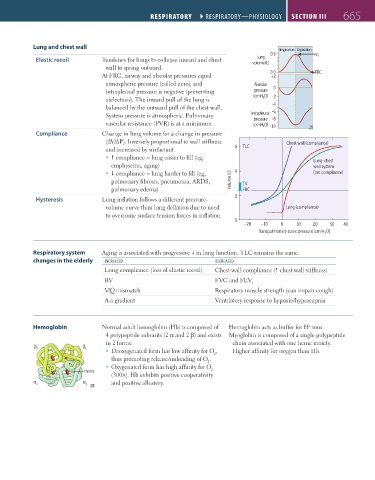
                  Lung and chest wall                                                              Inspiration Expiration
                                                                                                0.5            V T
                   Elastic recoil        Tendency for lungs to collapse inward and chest   Lung
                                          wall to spring outward.                         volume (L)
                                         At FRC, airway and alveolar pressures equal            0.0           FRC
                                                                                                +2
                                          atmospheric pressure (called zero), and          Alveolar
                                          intrapleural pressure is negative (preventing    pressure  0
                                          atelectasis). The inward pull of the lung is    (cm H   O)  -2
                                          balanced by the outward pull of the chest wall.       -4
                                          System pressure is atmospheric. Pulmonary       Intrapleural   -6
                                                                                                -8
                                          vascular resistance (PVR) is at a minimum.      pressure  -10
                                                                                          (cm H   O)
                   Compliance            Change in lung volume for a change in pressure
                                          (ΔV/ΔP). Inversely proportional to wall stiffness          Chest wall (compliance)
                                          and increased by surfactant.              6  TLC
                                             ƒ  compliance = lung easier to fill (eg,                        Lung-chest
                                            emphysema, aging)                                                 wall system
                                             ƒ  compliance = lung harder to fill (eg,   4                    (net compliance)
                                            pulmonary fibrosis, pneumonia, ARDS,   Volume (L)  TV
                                            pulmonary edema)                           FRC
                                                                                    2
                   Hysteresis            Lung inflation follows a different pressure-
                                          volume curve than lung deflation due to need               Lung (compliance)
                                          to overcome surface tension forces in inflation.
                                                                                    0
                                                                                       −20   −10   0    10    20   30   40
                                                                                            Transpulmonary static pressure (cm H O)
                                                                                                                 2

                  Respiratory system     Aging is associated with progressive  in lung function. TLC remains the same.
                  changes in the elderly  INCREASED                           DECREASED
                                          Lung compliance (loss of elastic recoil)  Chest wall compliance ( chest wall stiffness)
                                          RV                                  FVC and FEV
                                                                                          1
                                          ˙ ˙
                                          V/Q mismatch                        Respiratory muscle strength (can impair cough)
                                          A-a gradient                        Ventilatory response to hypoxia/hypercapnia


                  Hemoglobin             Normal adult hemoglobin (Hb) is composed of   Hemoglobin acts as buffer for H  ions.
                                                                                                            +
                                          4 polypeptide subunits (2 α and 2 β) and exists  Myoglobin is composed of a single polypeptide
                                          in 2 forms:                              chain associated with one heme moiety.
                   β               β
                                             ƒ Deoxygenated form has low affinity for O ,   Higher affinity for oxygen than Hb.
                    2              1
                                                                             2
                                            thus promoting release/unloading of O .
                                                                           2
                                             ƒ Oxygenated form has high affinity for O
                                   Heme                                     2
                                            (300×). Hb exhibits positive cooperativity
                   α               α        and positive allostery.
                   2                1


          FAS1_2019_16-Respiratory.indd   665                                                                           11/8/19   7:34 AM
   704   705   706   707   708   709   710   711   712   713   714