


Page 713 - First Aid for the USMLE Step 1 2020, Thirtieth edition [MedicalBooksVN.com]_Neat
P. 713
RespiRatoRy ` RESPIRATORY—PhYSIOlOgY RespiRatoRy ` RESPIRATORY—PhYSIOlOgY seCtioN iii 669
Oxygen deprivation
Hypoxia ( O delivery to tissue) Hypoxemia ( Pao ) Ischemia (loss of blood flow)
2 2
cardiac output Normal A-a gradient Impeded arterial flow
Hypoxemia High altitude venous drainage
Ischemia Hypoventilation (eg, opioid use,
Anemia obesity hypoventilation syndrome)
CO poisoning A-a gradient
˙ ˙
V/Q mismatch
Diffusion limitation (eg, fibrosis)
Right-to-left shunt
Ventilation/perfusion Ideally, ventilation is matched to perfusion (ie,
˙ ˙
mismatch V/Q = 1) for adequate gas exchange.
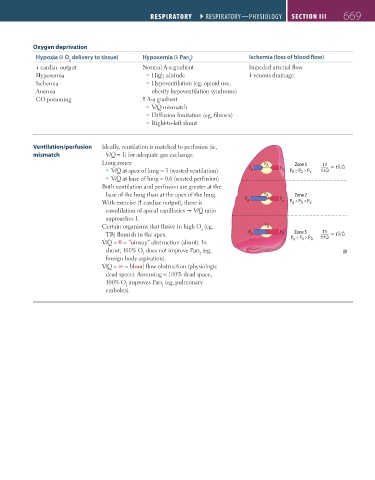
Lung zones: P A Zone 1 V V/Q
˙ ˙
V/Q at apex of lung = 3 (wasted ventilation) P a P v P ≥ P > P v Q
A
a
˙ ˙
V/Q at base of lung = 0.6 (wasted perfusion)
Both ventilation and perfusion are greater at the
base of the lung than at the apex of the lung. P A Zone 2
With exercise ( cardiac output), there is P a P v P > P > P v
A
a
˙ ˙
vasodilation of apical capillaries V/Q ratio
approaches 1.
Certain organisms that thrive in high O (eg, P A
2
TB) flourish in the apex. P a P v Zone 3 V V/Q
v
a
˙ ˙
V/Q = 0 = “oirway” obstruction (shunt). In P > P > P A Q
shunt, 100% O does not improve Pao (eg,
2
2
foreign body aspiration).
˙ ˙
V/Q = ∞ = blood flow obstruction (physiologic
dead space). Assuming < 100% dead space,
100% O improves Pao (eg, pulmonary
2
2
embolus).
FAS1_2019_16-Respiratory.indd 669 11/8/19 7:34 AM

