Page 714 - First Aid for the USMLE Step 1 2020, Thirtieth edition [MedicalBooksVN.com]_Neat
P. 714
670        seCtioN iii    RespiRatoRy  ` RESPIRATORY—PhYSIOlOgY                                                                                                         RespiRatoRy  ` RESPIRATORY—PAThOlOgY


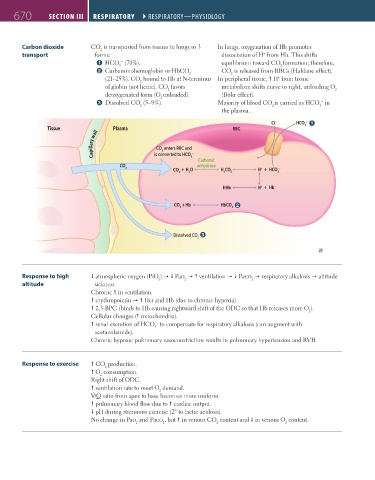
               Carbon dioxide        CO  is transported from tissues to lungs in 3   In lungs, oxygenation of Hb promotes
                                        2
               transport               forms:                                   dissociation of H  from Hb. This shifts
                                                                                             +
                                        1    HCO  (70%).                        equilibrium toward CO formation; therefore,
                                               −
                                              3
                                                                                                   2
                                        2    Carbaminohemoglobin or HbCO        CO  is released from RBCs (Haldane effect).
                                                                     2
                                                                                   2
                                          (21–25%). CO  bound to Hb at N-terminus  In peripheral tissue,  H  from tissue
                                                                                                  +
                                                     2
                                          of globin (not heme). CO  favors      metabolism shifts curve to right, unloading O
                                                              2
                                                                                                                     2
                                          deoxygenated form (O unloaded).       (Bohr effect).
                                                            2
                                        3    Dissolved CO  (5–9%).             Majority of blood CO is carried as HCO  in
                                                                                                                −
                                                     2                                          2               3
                                                                                the plasma.
                                                                                                Cl –    HCO 3 –  1
                       Tissue                       Plasma                          RBC
                                      Capillary wall       CO  enters RBC and
                                                            2
                                                                      –
                                                          is converted to HCO
                                                                      3
                                                                        Carbonic
                                               CO                       anhydrase
                                                 2
                                                                CO +  H O       H CO        H +  HCO  –
                                                                                             +
                                                                  2  2           2  3             3
                                                                                HHb         H +  Hb –
                                                                                             +
                                                                CO  + Hb        HbCO 2
                                                                  2
                                                                                   2
                                                                Dissolved CO 3
                                                                        2


               Response to high       atmospheric oxygen (PiO ) Ž  Pao  Ž  ventilation Ž  Paco  Ž respiratory alkalosis Ž altitude
                                                                    2
                                                                                          2
                                                           2
               altitude               sickness.
                                     Chronic  in ventilation.
                                      erythropoietin Ž  Hct and Hb (due to chronic hypoxia).
                                      2,3-BPG (binds to Hb causing rightward shift of the ODC so that Hb releases more O ).
                                                                                                            2
                                     Cellular changes ( mitochondria).
                                                           −
                                      renal excretion of HCO  to compensate for respiratory alkalosis (can augment with
                                                          3
                                      acetazolamide).
                                     Chronic hypoxic pulmonary vasoconstriction results in pulmonary hypertension and RVH.


               Response to exercise    CO  production.
                                          2
                                      O  consumption.
                                        2
                                     Right shift of ODC.
                                      ventilation rate to meet O  demand.
                                                            2
                                      ˙ ˙
                                     V/Q  ratio from apex to base becomes more uniform.
                                      pulmonary blood flow due to  cardiac output.
                                      pH during strenuous exercise (2° to lactic acidosis).
                                     No change in Pao  and Paco , but  in venous CO  content and  in venous O  content.
                                                                                                     2
                                                    2
                                                             2
                                                                              2


          FAS1_2019_16-Respiratory.indd   670                                                                           11/8/19   7:34 AM
   709   710   711   712   713   714   715   716   717   718   719