Page 711 - First Aid for the USMLE Step 1 2020, Thirtieth edition [MedicalBooksVN.com]_Neat
P. 711
RespiRatoRy  ` RESPIRATORY—PhYSIOlOgY                   RespiRatoRy  ` RESPIRATORY—PhYSIOlOgY         seCtioN iii      667


                  Cyanide vs carbon      Both inhibit aerobic metabolism via inhibition of complex IV (cytochrome c oxidase) Ž hypoxia
                  monoxide poisoning      that does not fully correct with supplemental O  and  anaerobic metabolism.
                                                                                2
                                         Both can lead to pink or cherry red skin (usually postmortem finding), seizures, and coma.
                                         Cyanide                                  Carbon monoxide
                  SOURCE                 Byproduct of synthetic product combustion,   Odorless gas from fires, car exhaust, or gas
                                          ingestion of amygdalin (cyanogenic glucoside   heaters.
                                          found in apricot seeds) or cyanide.
                  TREATmENT              Hydroxocobalamin (binds cyanide          100% O , hyperbaric O .
                                                                                         2           2
                                          Ž cyanocobalamin Ž renal excretion).
                                         Nitrites (oxidize Hb Ž methemoglobin Ž binds
                                          cyanide Ž cyanomethemoglobin Ž less
                                          toxicity).
                                         Sodium thiosulfate ( cyanide conversion to
                                          thiocyanate Ž renal excretion).

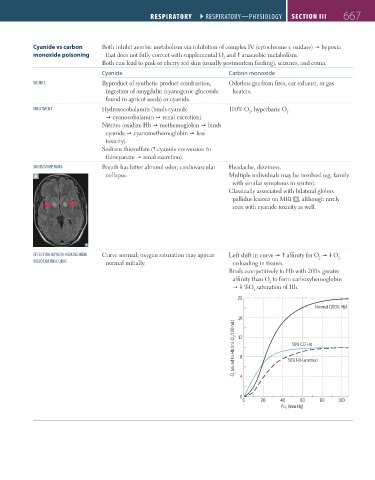
                  SIgNS/SYmPTOmS         Breath has bitter almond odor; cardiovascular   Headache, dizziness.
                   A                      collapse.                               Multiple individuals may be involved (eg, family
                                                                                    with similar symptoms in winter).
                                                                                  Classically associated with bilateral globus
                                                                                    pallidus lesions on MRI  A , although rarely
                                                                                   seen with cyanide toxicity as well.


                  EFFECT ON OXYgEN-hEmOglObIN   Curve normal; oxygen saturation may appear   Left shift in curve Ž  affinity for O  Ž  O
                  DISSOCIATION CURVE      normal initially.                        unloading in tissues.        2     2
                                                                                  Binds competitively to Hb with 200× greater
                                                                                   affinity than O  to form carboxyhemoglobin
                                                                                                2
                                                                                    Ž  %O  saturation of Hb.
                                                                                          2
                                                                                     20
                                                                                                              Normal (100% Hb)
                                                                                    O 2  bound to Hb (mL O 2  /100 mL) 16 8  50% Hb (anemia)


                                                                                     12
                                                                                                       50% CO Hb


                                                                                      0 4
                                                                                       0     20    40     60    80    100
                                                                                                   PO  (mm Hg)
                                                                                                     2


          FAS1_2019_16-Respiratory.indd   667                                                                           11/8/19   7:34 AM
   706   707   708   709   710   711   712   713   714   715   716