Page 94 - First Aid for the USMLE Step 1 2020, Thirtieth edition [MedicalBooksVN.com]_Neat
P. 94
50          SECTION II    BIOCHEmISTRY  ``BIOCHEMISTRY—CEllUlAR                                                                                                        BIOCHEmISTRY  ``BIOCHEMISTRY—CEllUlAR


               Collagen              Most abundant protein in the human body.   Be So Totally Cool, Read Books.
                                     Extensively modified by posttranslational
                                       modification.
                                     Organizes and strengthens extracellular matrix.
                 Type I              Most common (90%)—Bone (made by           Type I: bone.
                                      osteoblasts), Skin, Tendon, dentin, fascia,    production in osteogenesis imperfecta type I.
                                      cornea, late wound repair.
                 Type II             Cartilage (including hyaline), vitreous body,   Type II: cartwolage.
                                      nucleus pulposus.
                 Type III            Reticulin—skin, blood vessels, uterus, fetal   Type III: deficient in the uncommon, vascular
                                      tissue, early wound repair.               type of Ehlers-Danlos syndrome (ThreE D).
                 Type IV             Basement membrane (basal lamina), lens.   Type IV: under the floor (basement membrane).
                                                                               Defective in Alport syndrome; targeted by
                                                                                autoantibodies in Goodpasture syndrome.


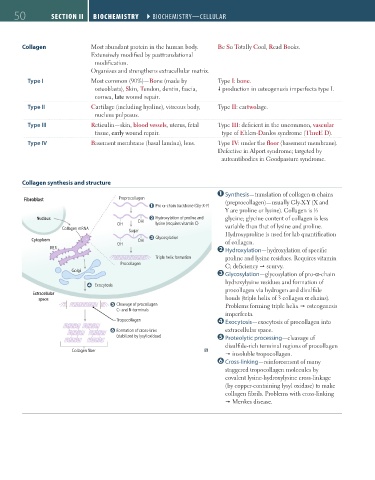
               Collagen synthesis and structure

                                                                                   Synthesis—translation of collagen α chains
               Fibroblast                     Preprocollagen                     (preprocollagen)—usually Gly-X-Y (X and
                                                          Pro α-chain backbone (Gly-X-Y)
                                                                                 Y are proline or lysine). Collagen is  ⁄3
                                                                                                              1
                    Nucleus                          OH   Hydroxylation of proline and  glycine; glycine content of collagen is less
                                              OH          lysine (requires vitamin C)  variable than that of lysine and proline.
                            Collagen mRNA         Sugar
                                                          Glycosylation          Hydroxyproline is used for lab quantification
                  Cytoplasm                          OH                          of collagen.
                                              OH
                        RER
                                                                                   Hydroxylation—hydroxylation of specific
                                                          Triple helix formation  proline and lysine residues. Requires vitamin
                                               Procollagen                       C; deficiency Ž scurvy.
                               Golgi
                                                                                   Glycosylation—glycosylation of pro-α-chain
                                                                                 hydroxylysine residues and formation of
                                       Exocytosis
                                                                                 procollagen via hydrogen and disulfide
                  Extracellular
                    space                                                        bonds (triple helix of 3 collagen α chains).
                                              Cleavage of procollagen            Problems forming triple helix Ž osteogenesis
                                              C- and N-terminals
                                                                                 imperfecta.
                                              Tropocollagen                        Exocytosis—exocytosis of procollagen into
                                              Formation of cross-links           extracellular space.
                                              (stabilized by lysyl oxidase)        Proteolytic processing—cleavage of
                                                                                 disulfide-rich terminal regions of procollagen
                               Collagen fiber
                                                                                 Ž insoluble tropocollagen.
                                                                                   Cross-linking—reinforcement of many
                                                                                 staggered tropocollagen molecules by
                                                                                 covalent lysine-hydroxylysine cross-linkage
                                                                                 (by copper-containing lysyl oxidase) to make
                                                                                 collagen fibrils. Problems with cross-linking
                                                                                 Ž Menkes disease.


          FAS1_2019_01-Biochem.indd   50                                                                                11/7/19   3:16 PM
   89   90   91   92   93   94   95   96   97   98   99