


Page 95 - First Aid for the USMLE Step 1 2020, Thirtieth edition [MedicalBooksVN.com]_Neat
P. 95
BIOCHEmISTRY ``BIOCHEMISTRY—CEllUlAR BIOCHEmISTRY ``BIOCHEMISTRY—CEllUlAR SECTION II 51
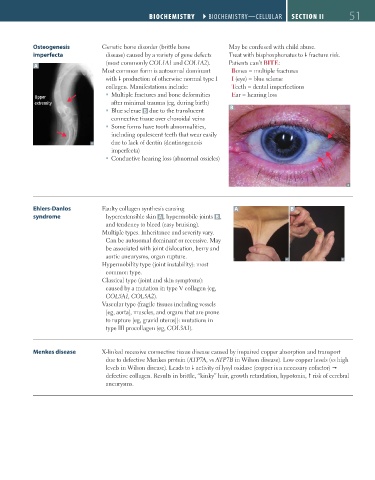
Osteogenesis Genetic bone disorder (brittle bone May be confused with child abuse.
imperfecta disease) caused by a variety of gene defects Treat with bisphosphonates to fracture risk.
(most commonly COL1A1 and COL1A2). Patients can’t BITE:
A
Most common form is autosomal dominant Bones = multiple fractures
with production of otherwise normal type I I (eye) = blue sclerae
collagen. Manifestations include: Teeth = dental imperfections
Multiple fractures and bone deformities Ear = hearing loss
Upper
extremity after minimal trauma (eg, during birth)
Blue sclerae B due to the translucent B
connective tissue over choroidal veins
Some forms have tooth abnormalities,
including opalescent teeth that wear easily
due to lack of dentin (dentinogenesis
imperfecta)
Conductive hearing loss (abnormal ossicles)
Ehlers-Danlos Faulty collagen synthesis causing A B
syndrome hyperextensible skin A , hypermobile joints B ,
and tendency to bleed (easy bruising).
Multiple types. Inheritance and severity vary.
Can be autosomal dominant or recessive. May
be associated with joint dislocation, berry and
aortic aneurysms, organ rupture.
Hypermobility type (joint instability): most
common type.
Classical type (joint and skin symptoms):
caused by a mutation in type V collagen (eg,
COL5A1, COL5A2).
Vascular type (fragile tissues including vessels
[eg, aorta], muscles, and organs that are prone
to rupture [eg, gravid uterus]): mutations in
type III procollagen (eg, COL3A1).
Menkes disease X-linked recessive connective tissue disease caused by impaired copper absorption and transport
due to defective Menkes protein (ATP7A, vs ATP7B in Wilson disease). Low copper levels (vs high
levels in Wilson disease). Leads to activity of lysyl oxidase (copper is a necessary cofactor)
defective collagen. Results in brittle, “kinky” hair, growth retardation, hypotonia, risk of cerebral
aneurysms.
FAS1_2019_01-Biochem.indd 51 11/7/19 3:16 PM

