


Page 100 - First Aid for the USMLE Step 1 2020, Thirtieth edition [MedicalBooksVN.com]_Neat
P. 100
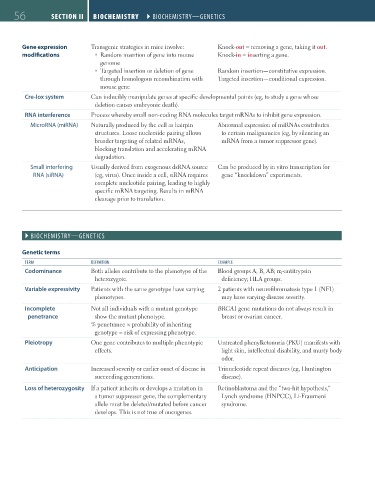
56 SECTION II BIOCHEmISTRY ``BIOCHEMISTRY—GENETICS BIOCHEmISTRY ``BIOCHEMISTRY—GENETICS
Gene expression Transgenic strategies in mice involve: Knock-out = removing a gene, taking it out.
modifications Random insertion of gene into mouse Knock-in = inserting a gene.
genome
Targeted insertion or deletion of gene Random insertion—constitutive expression.
through homologous recombination with Targeted insertion—conditional expression.
mouse gene
Cre-lox system Can inducibly manipulate genes at specific developmental points (eg, to study a gene whose
deletion causes embryonic death).
RNA interference Process whereby small non-coding RNA molecules target mRNAs to inhibit gene expression.
MicroRNA (miRNA) Naturally produced by the cell as hairpin Abnormal expression of miRNAs contributes
structures. Loose nucleotide pairing allows to certain malignancies (eg, by silencing an
broader targeting of related mRNAs, mRNA from a tumor suppressor gene).
blocking translation and accelerating mRNA
degradation.
Small interfering Usually derived from exogenous dsRNA source Can be produced by in vitro transcription for
RNA (siRNA) (eg, virus). Once inside a cell, siRNA requires gene “knockdown” experiments.
complete nucleotide pairing, leading to highly
specific mRNA targeting. Results in mRNA
cleavage prior to translation.
` `BIOCHEMISTRY—GENETICS
Genetic terms
TERM DEFINITION EXAMPlE
Codominance Both alleles contribute to the phenotype of the Blood groups A, B, AB; α 1 -antitrypsin
heterozygote. deficiency; HLA groups.
Variable expressivity Patients with the same genotype have varying 2 patients with neurofibromatosis type 1 (NF1)
phenotypes. may have varying disease severity.
Incomplete Not all individuals with a mutant genotype BRCA1 gene mutations do not always result in
penetrance show the mutant phenotype. breast or ovarian cancer.
% penetrance × probability of inheriting
genotype = risk of expressing phenotype.
Pleiotropy One gene contributes to multiple phenotypic Untreated phenylketonuria (PKU) manifests with
effects. light skin, intellectual disability, and musty body
odor.
Anticipation Increased severity or earlier onset of disease in Trinucleotide repeat diseases (eg, Huntington
succeeding generations. disease).
Loss of heterozygosity If a patient inherits or develops a mutation in Retinoblastoma and the “two-hit hypothesis,”
a tumor suppressor gene, the complementary Lynch syndrome (HNPCC), Li-Fraumeni
allele must be deleted/mutated before cancer syndrome.
develops. This is not true of oncogenes.
FAS1_2019_01-Biochem.indd 56 11/7/19 3:16 PM

