


Page 181 - The City and Guilds Textbook: Plumbing Book 1 for the Level 3 Apprenticeship (9189), Level 2 Technical Certificate (8202) and Level 2 Diploma (6035)
P. 181
Chapter 3 Scientific principles
Methods of heat transfer
So far we have investigated temperature and heat, and how these affect the
different states of matter. Now, we will consider the methods of heat transfer.
There are three methods by which heat can be transferred through a substance
or from one substance to another. These are:
1 conduction
2 convection
3 radiation.
We will look at each one in turn.
Conduction
Conduction happens when heat travels through a substance, with the heat being
transferred from one molecule to another.
Consider a piece of copper tube. If heat is applied to one end, before long the
heat will have travelled through the material so that the effects of the heat will
be felt at the other end. This occurs because kinetic energy in the form of heat
is being passed from one copper molecule to another very quickly. When the
copper is cold, the atoms move very slowly. As heat is applied, these atoms gain
speed and collide with the slower, cooler atoms. In this way, some of the kinetic Table 3.13 Coefficient thermal
energy is passed through the material, the slow atoms becoming faster and conductivity of common
colliding with other slow atoms, and so on. substances
Not all substances, however, transfer heat at the same rate. Some materials, Thermal
such as plastic or wood, are very poor at transferring heat, with little or no heat conductivity
transference occurring at all. Material W/m/K
Silver 406.0
Most metals are very good conductors of heat and, because of this, they are
also very good at conducting electricity. Materials that do not transfer heat Copper 385.0
well, such as plastic, are known as insulators. Gold 310
Aluminium 205.0
IMPROVE YOUR MATHS Brass 109.0
The rate at which a material will transfer heat is known as the coefficient of Steel 50.2
thermal conductivity, which is measured in W/m/K. It can be found using the Lead 34.7
following equation: Concrete 0.8
heat × distance
Thermal conductivity = Polyethylene 0.5
area × temperature difference HD
Wood 0.12–0.04
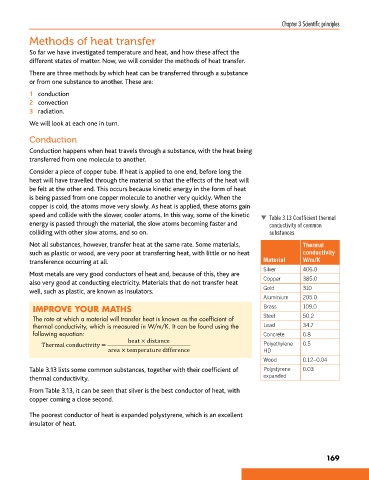
Table 3.13 lists some common substances, together with their coefficient of Polystyrene 0.03
thermal conductivity. expanded
From Table 3.13, it can be seen that silver is the best conductor of heat, with
copper coming a close second.
The poorest conductor of heat is expanded polystyrene, which is an excellent
insulator of heat.
169
9781510416482.indb 169 29/03/19 8:55 PM

