


Page 180 - The City and Guilds Textbook: Plumbing Book 1 for the Level 3 Apprenticeship (9189), Level 2 Technical Certificate (8202) and Level 2 Diploma (6035)
P. 180
The City & Guilds Textbook: Plumbing Book 1


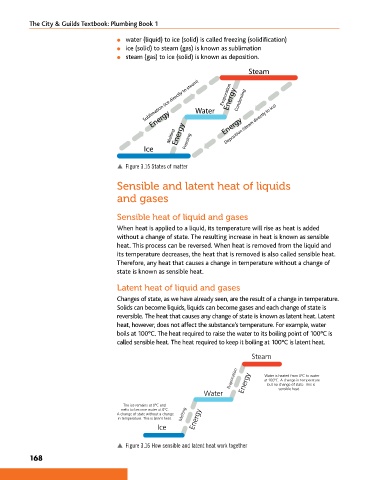
                                            l  water (liquid) to ice (solid) is called freezing (solidification)
                                            l  ice (solid) to steam (gas) is known as sublimation
                                            l  steam (gas) to ice (solid) is known as deposition.

                                                                                       Steam
                                                     Sublimation (ice directly to steam) Water   Evaporation Energy  Condensing


                                                                               Deposition (steam directly to ice)
                                                       Energy


                                                             Melting  Energy  Freezing  Energy


                                                     Ice

                                            p  Figure 3.15 States of matter


                                            Sensible and latent heat of liquids
                                            and gases


                                            Sensible heat of liquid and gases

                                            When heat is applied to a liquid, its temperature will rise as heat is added
                                            without a change of state. The resulting increase in heat is known as sensible
                                            heat. This process can be reversed. When heat is removed from the liquid and
                                            its temperature decreases, the heat that is removed is also called sensible heat.
                                            Therefore, any heat that causes a change in temperature without a change of
                                            state is known as sensible heat.
                                            Latent heat of liquid and gases

                                            Changes of state, as we have already seen, are the result of a change in temperature.
                                            Solids can become liquids, liquids can become gases and each change of state is
                                            reversible. The heat that causes any change of state is known as latent heat. Latent
                                            heat, however, does not affect the substance’s temperature. For example, water
                                            boils at 100°C. The heat required to raise the water to its boiling point of 100°C is
                                            called sensible heat. The heat required to keep it boiling at 100°C is latent heat.
                                                                                        Steam


                                                                                 Evaporation  Energy  at 100ºC. A change in temperature
                                                                                            Water is heated from 0ºC to water
                                                                                             but no change of state. This is
                                                                        Water                    sensible heat.

                                              The ice remains at 0ºC and
                                             melts to become water at 0ºC.
                                            A change of state without a change   Melting
                                             in temperature. This is latent heat.  Energy
                                                         Ice


                                            p  Figure 3.16 How sensible and latent heat work together
                168


        9781510416482.indb   168                                                                                    29/03/19   8:55 PM

