


Page 182 - The City and Guilds Textbook: Plumbing Book 1 for the Level 3 Apprenticeship (9189), Level 2 Technical Certificate (8202) and Level 2 Diploma (6035)
P. 182
The City & Guilds Textbook: Plumbing Book 1

                                            The coefficient of linear expansion
                                            Most materials expand when they are heated. When copper pipework expands
                                            it can often be heard as a ticking when the central heating is on. The copper
                                            expands in length by 0.000018 mm/°C. This may not seem a lot, but when it is
                                            considered that this figure is for every degree rise in temperature, then the length
                                            of expansion can be significant. On larger installations, it may mean the use of
                                            expansion joints to accommodate the amount of expansion so that damage to
                                            the pipework is eliminated. PVCu expands by a greater amount of 0.0005 mm/°C.

                                             IMPROVE YOUR MATHS

                                             Let’s see by how much copper expands.
                                             20 m of 22 mm copper pipe contains water that rises from 4°C to 85°C. By how
                                             much does the copper expand?
                                             There is 20 m of copper pipe, an 81°C temperature difference and a 0.000018
                                             coefficient of expansion of copper, so:
                                                20 m × 81°C × 0.000018 mm/°C = 29.16 mm


                                            Convection
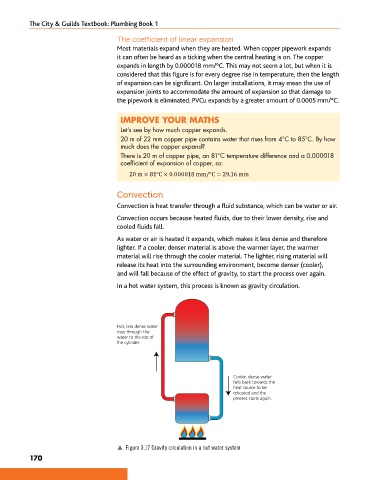
                                            Convection is heat transfer through a fluid substance, which can be water or air.

                                            Convection occurs because heated fluids, due to their lower density, rise and
                                            cooled fluids fall.

                                            As water or air is heated it expands, which makes it less dense and therefore
                                            lighter. If a cooler, denser material is above the warmer layer, the warmer
                                            material will rise through the cooler material. The lighter, rising material will
                                            release its heat into the surrounding environment, become denser (cooler),
                                            and will fall because of the effect of gravity, to start the process over again.
                                            In a hot water system, this process is known as gravity circulation.


                                            Hot, less dense water
                                            rises through the
                                            water to the top of
                                            the cylinder.


                                                                                  Cooler, dense water
                                                                                  falls back towards the
                                                                                  heat source to be
                                                                                  reheated and the
                                                                                  process starts again.


                                            p  Figure 3.17 Gravity circulation in a hot water system
                170


        9781510416482.indb   170                                                                                    29/03/19   8:55 PM

