


Page 185 - The City and Guilds Textbook: Plumbing Book 1 for the Level 3 Apprenticeship (9189), Level 2 Technical Certificate (8202) and Level 2 Diploma (6035)
P. 185
Chapter 3 Scientific principles
4 THE PRINCIPLES OF FORCE
AND PRESSURE, AND THEIR
APPLICATION IN THE PLUMBING
AND HEATING INDUSTRY
In this part of the chapter, we will look at the scientific principles of force and
pressure, and investigate how they apply to the building services industry.
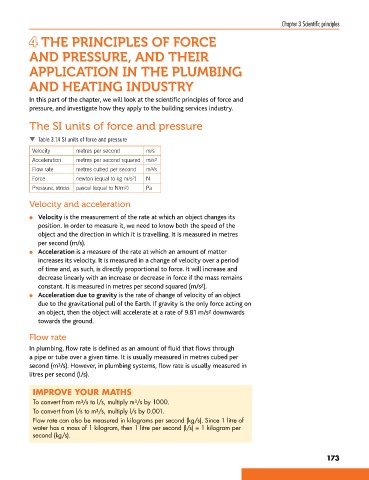
The SI units of force and pressure
Table 3.14 SI units of force and pressure
Velocity metres per second m/s
Acceleration metres per second squared m/s 2
Flow rate metres cubed per second m 3 /s
Force newton (equal to kg m/s 2 ) N
Pressure, stress pascal (equal to N/m 2 ) Pa
Velocity and acceleration
l Velocity is the measurement of the rate at which an object changes its
position. In order to measure it, we need to know both the speed of the
object and the direction in which it is travelling. It is measured in metres
per second (m/s).
l Acceleration is a measure of the rate at which an amount of matter
increases its velocity. It is measured in a change of velocity over a period
of time and, as such, is directly proportional to force. It will increase and
decrease linearly with an increase or decrease in force if the mass remains
constant. It is measured in metres per second squared (m/s ).
2
l Acceleration due to gravity is the rate of change of velocity of an object
due to the gravitational pull of the Earth. If gravity is the only force acting on
an object, then the object will accelerate at a rate of 9.81 m/s downwards
2
towards the ground.
Flow rate
In plumbing, flow rate is defined as an amount of fluid that flows through
a pipe or tube over a given time. It is usually measured in metres cubed per
3
second (m /s). However, in plumbing systems, flow rate is usually measured in
litres per second (l/s).
IMPROVE YOUR MATHS
To convert from m /s to l/s, multiply m /s by 1000.
3
3
To convert from l/s to m 3 /s, multiply l/s by 0.001.
Flow rate can also be measured in kilograms per second (kg/s). Since 1 litre of
water has a mass of 1 kilogram, then 1 litre per second (l/s) = 1 kilogram per
second (kg/s).
173
9781510416482.indb 173 29/03/19 8:55 PM

