


Page 184 - The City and Guilds Textbook: Plumbing Book 1 for the Level 3 Apprenticeship (9189), Level 2 Technical Certificate (8202) and Level 2 Diploma (6035)
P. 184
The City & Guilds Textbook: Plumbing Book 1


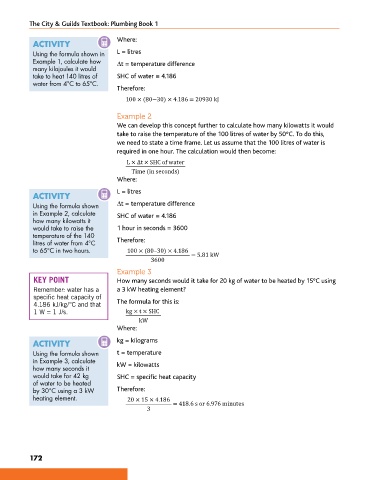
                 ACTIVITY                   Where:

                 Using the formula shown in   L = litres
                 Example 1, calculate how   Δt = temperature difference
                 many kilojoules it would
                 take to heat 140 litres of   SHC of water = 4.186
                 water from 4°C to 65°C.
                                            Therefore:
                                               100 × (80−30) × 4.186 = 20930 kJ

                                            Example 2
                                            We can develop this concept further to calculate how many kilowatts it would
                                            take to raise the temperature of the 100 litres of water by 50°C. To do this,
                                            we need to state a time frame. Let us assume that the 100 litres of water is
                                            required in one hour. The calculation would then become:

                                               L × Δt × SHC of water
                                                 Time (in seconds)
                                            Where:

                 ACTIVITY                   L = litres
                 Using the formula shown    Δt = temperature difference
                 in Example 2, calculate    SHC of water = 4.186
                 how many kilowatts it
                 would take to raise the    1 hour in seconds = 3600
                 temperature of the 140
                 litres of water from 4°C   Therefore:
                 to 65°C in two hours.          100 × (80–30) × 4.186
                                                                     = 5.81 kW
                                                       3600
                                            Example 3
                 KEY POINT                  How many seconds would it take for 20 kg of water to be heated by 15°C using
                 Remember: water has a      a 3 kW heating element?
                 specific heat capacity of
                 4.186 kJ/kg/°C and that    The formula for this is:
                 1 W = 1 J/s.                  kg × t × SHC
                                                   kW
                                            Where:

                 ACTIVITY                   kg = kilograms
                 Using the formula shown    t = temperature
                 in Example 3, calculate    kW = kilowatts
                 how many seconds it
                 would take for 42 kg       SHC = specific heat capacity
                 of water to be heated
                 by 30°C using a 3 kW       Therefore:
                 heating element.               20 × 15 × 4.186
                                                               = 418.6 s or 6.976 minutes
                                                      3


                172


        9781510416482.indb   172                                                                                    29/03/19   8:55 PM

