


Page 188 - The City and Guilds Textbook: Plumbing Book 1 for the Level 3 Apprenticeship (9189), Level 2 Technical Certificate (8202) and Level 2 Diploma (6035)
P. 188
The City & Guilds Textbook: Plumbing Book 1
Table 3.15 Conversions for Table 3.15 shows the conversions for common units of head of pressure.
common units of head of pressure
Dynamic pressure
Metres
Kilopascals head Also called working pressure, dynamic pressure is the pressure of water while it
(kPa) Bar of water is in motion. In other words, it is the pressure of flowing water. If the pressure of
10 0.1 1 the water is increased, the velocity and flow rate will also increase.
20 0.2 2 Atmospheric pressure
30 0.3 3
Atmospheric pressure is the amount of force or pressure exerted by the
40 0.4 4 atmosphere on the Earth and the objects located on it. The more pressure
50 0.5 5 there is, the stronger that force will be; at sea level, the atmospheric pressure
100 1 10 is 101.325 kPa. This is known as 1 atmosphere (atm). Atmospheric pressure
150 1.5 15 decreases with height.
200 2 20
250 2.5 25 The principle of a siphon (siphonic action) due to atmospheric
300 3 30 pressure
The principle of a siphon is to discharge water from a high vessel to a lower
350 3.5 35
vessel using atmospheric pressure and the cohesive properties of water.
400 4 40
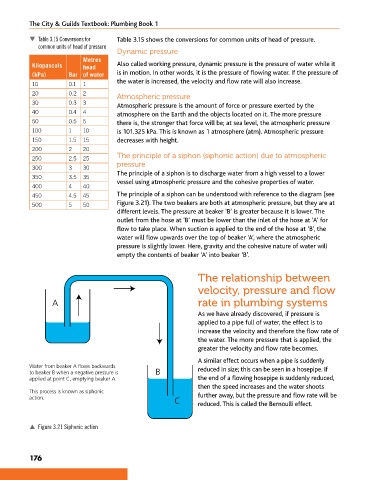
450 4.5 45 The principle of a siphon can be understood with reference to the diagram (see
500 5 50 Figure 3.21). The two beakers are both at atmospheric pressure, but they are at
different levels. The pressure at beaker ‘B’ is greater because it is lower. The
outlet from the hose at ‘B’ must be lower than the inlet of the hose at ‘A’ for
flow to take place. When suction is applied to the end of the hose at ‘B’, the
water will flow upwards over the top of beaker ‘A’, where the atmospheric
pressure is slightly lower. Here, gravity and the cohesive nature of water will
empty the contents of beaker ‘A’ into beaker ‘B’.
The relationship between
velocity, pressure and flow
A rate in plumbing systems
As we have already discovered, if pressure is
applied to a pipe full of water, the effect is to
increase the velocity and therefore the flow rate of
the water. The more pressure that is applied, the
greater the velocity and flow rate becomes.
A similar effect occurs when a pipe is suddenly
Water from beaker A flows backwards reduced in size; this can be seen in a hosepipe. If
to beaker B when a negative pressure is B
applied at point C, emptying beaker A. the end of a flowing hosepipe is suddenly reduced,
then the speed increases and the water shoots
This process is known as siphonic
action. further away, but the pressure and flow rate will be
C reduced. This is called the Bernoulli effect.
p Figure 3.21 Siphonic action
176
9781510416482.indb 176 29/03/19 8:55 PM

