


Page 183 - The City and Guilds Textbook: Plumbing Book 1 for the Level 3 Apprenticeship (9189), Level 2 Technical Certificate (8202) and Level 2 Diploma (6035)
P. 183
Chapter 3 Scientific principles
Modern radiators in central heating systems use two methods of heat transfer,
with convection being the main heat transfer method. The other is radiation.
Radiation
The third method of heat transfer is radiation. Radiation heat transfer is thermal
radiation from infrared light, visible or not, which transfers heat from one body
to another without heating the space in between. Like all forms of light, thermal
radiation travels in straight lines.
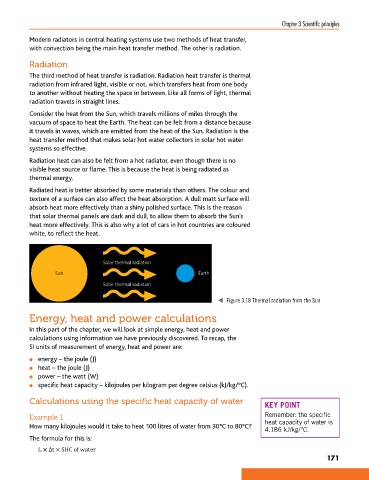
Consider the heat from the Sun, which travels millions of miles through the
vacuum of space to heat the Earth. The heat can be felt from a distance because
it travels in waves, which are emitted from the heat of the Sun. Radiation is the
heat transfer method that makes solar hot water collectors in solar hot water
systems so effective.
Radiation heat can also be felt from a hot radiator, even though there is no
visible heat source or flame. This is because the heat is being radiated as
thermal energy.
Radiated heat is better absorbed by some materials than others. The colour and
texture of a surface can also affect the heat absorption. A dull matt surface will
absorb heat more effectively than a shiny polished surface. This is the reason
that solar thermal panels are dark and dull, to allow them to absorb the Sun’s
heat more effectively. This is also why a lot of cars in hot countries are coloured
white, to reflect the heat.
Solar thermal radiation
Sun Earth
Solar thermal radiation
Figure 3.18 Thermal radiation from the Sun
Energy, heat and power calculations
In this part of the chapter, we will look at simple energy, heat and power
calculations using information we have previously discovered. To recap, the
SI units of measurement of energy, heat and power are:
l energy – the joule (J)
l heat – the joule (J)
l power – the watt (W)
l specific heat capacity – kilojoules per kilogram per degree celsius (kJ/kg/°C).
Calculations using the specific heat capacity of water KEY POINT
Example 1 Remember: the specific
heat capacity of water is
How many kilojoules would it take to heat 100 litres of water from 30°C to 80°C? 4.186 kJ/kg/°C.
The formula for this is:
L × Δt × SHC of water
171
9781510416482.indb 171 29/03/19 8:55 PM

