


Page 189 - The City and Guilds Textbook: Plumbing Book 1 for the Level 3 Apprenticeship (9189), Level 2 Technical Certificate (8202) and Level 2 Diploma (6035)
P. 189
Chapter 3 Scientific principles
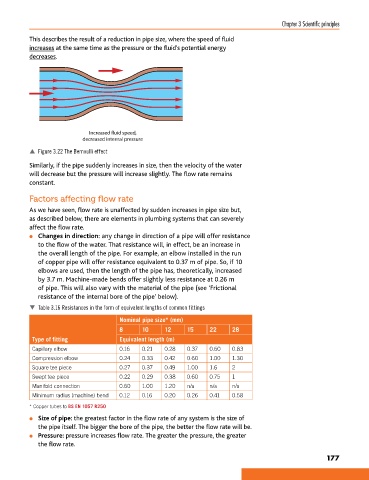
This describes the result of a reduction in pipe size, where the speed of fluid
increases at the same time as the pressure or the fluid’s potential energy
decreases.
Increased fluid speed,
decreased internal pressure
p Figure 3.22 The Bernoulli effect
Similarly, if the pipe suddenly increases in size, then the velocity of the water
will decrease but the pressure will increase slightly. The flow rate remains
constant.
Factors affecting flow rate
As we have seen, flow rate is unaffected by sudden increases in pipe size but,
as described below, there are elements in plumbing systems that can severely
affect the flow rate.
l Changes in direction: any change in direction of a pipe will offer resistance
to the flow of the water. That resistance will, in effect, be an increase in
the overall length of the pipe. For example, an elbow installed in the run
of copper pipe will offer resistance equivalent to 0.37 m of pipe. So, if 10
elbows are used, then the length of the pipe has, theoretically, increased
by 3.7 m. Machine-made bends offer slightly less resistance at 0.26 m
of pipe. This will also vary with the material of the pipe (see ‘Frictional
resistance of the internal bore of the pipe’ below).
Table 3.16 Resistances in the form of equivalent lengths of common fittings
Nominal pipe size* (mm)
8 10 12 15 22 28
Type of fitting Equivalent length (m)
Capillary elbow 0.16 0.21 0.28 0.37 0.60 0.83
Compression elbow 0.24 0.33 0.42 0.60 1.00 1.30
Square tee piece 0.27 0.37 0.49 1.00 1.6 2
Swept tee piece 0.22 0.29 0.38 0.60 0.75 1
Manifold connection 0.60 1.00 1.20 n/a n/a n/a
Minimum radius (machine) bend 0.12 0.16 0.20 0.26 0.41 0.58
* Copper tubes to BS EN 1057 R250
l Size of pipe: the greatest factor in the flow rate of any system is the size of
the pipe itself. The bigger the bore of the pipe, the better the flow rate will be.
l Pressure: pressure increases flow rate. The greater the pressure, the greater
the flow rate.
177
9781510416482.indb 177 29/03/19 8:55 PM

