


Page 193 - The City and Guilds Textbook: Plumbing Book 1 for the Level 3 Apprenticeship (9189), Level 2 Technical Certificate (8202) and Level 2 Diploma (6035)
P. 193
Chapter 3 Scientific principles

                Basic mechanics: moments of a force

                (torque)

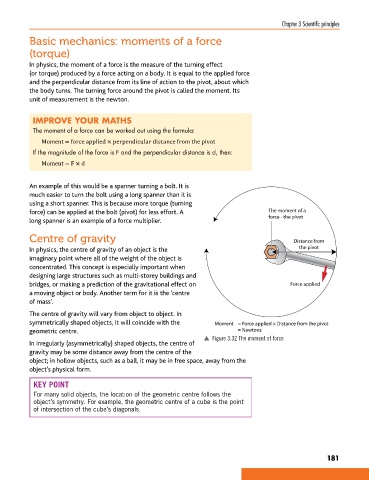
                In physics, the moment of a force is the measure of the turning effect
                (or torque) produced by a force acting on a body. It is equal to the applied force
                and the perpendicular distance from its line of action to the pivot, about which
                the body turns. The turning force around the pivot is called the moment. Its
                unit of measurement is the newton.


                 IMPROVE YOUR MATHS
                 The moment of a force can be worked out using the formula:

                    Moment = force applied × perpendicular distance from the pivot
                 If the magnitude of the force is F and the perpendicular distance is d, then:

                    Moment = F × d


                An example of this would be a spanner turning a bolt. It is
                much easier to turn the bolt using a long spanner than it is
                using a short spanner. This is because more torque (turning
                force) can be applied at the bolt (pivot) for less effort. A                 The moment of a
                                                                                             force - the pivot
                long spanner is an example of a force multiplier.
                Centre of gravity                                                                    Distance from

                In physics, the centre of gravity of an object is the                                  the pivot
                imaginary point where all of the weight of the object is
                concentrated. This concept is especially important when
                designing large structures such as multi-storey buildings and
                bridges, or making a prediction of the gravitational effect on                      Force applied
                a moving object or body. Another term for it is the ‘centre
                of mass’.
                The centre of gravity will vary from object to object. In
                symmetrically shaped objects, it will coincide with the     Moment   = Force applied × Distance from the pivot
                geometric centre.                                                   = Newtons
                                                                        p  Figure 3.32 The moment of force
                In irregularly (asymmetrically) shaped objects, the centre of
                gravity may be some distance away from the centre of the
                object; in hollow objects, such as a ball, it may be in free space, away from the
                object’s physical form.

                 KEY POINT
                 For many solid objects, the location of the geometric centre follows the
                 object’s symmetry. For example, the geometric centre of a cube is the point
                 of intersection of the cube’s diagonals.


                                                                                                                181


        9781510416482.indb   181                                                                                    29/03/19   8:55 PM

