


Page 192 - The City and Guilds Textbook: Plumbing Book 1 for the Level 3 Apprenticeship (9189), Level 2 Technical Certificate (8202) and Level 2 Diploma (6035)
P. 192
The City & Guilds Textbook: Plumbing Book 1


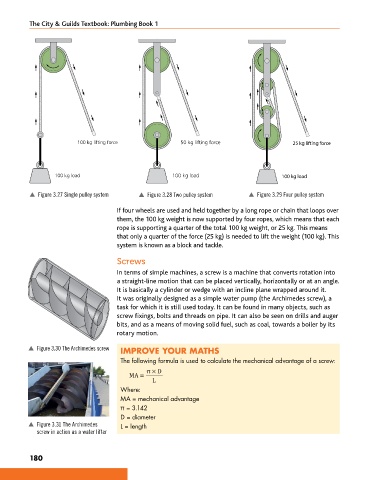
                               100 kg lifting force              50 kg lifting force                 25 kg lifting force


                        100 kg load                           100 kg load                         100 kg load


                p  Figure 3.27 Single pulley system  p  Figure 3.28 Two pulley system  p  Figure 3.29 Four pulley system

                                            If four wheels are used and held together by a long rope or chain that loops over
                                            them, the 100 kg weight is now supported by four ropes, which means that each
                                            rope is supporting a quarter of the total 100 kg weight, or 25 kg. This means
                                            that only a quarter of the force (25 kg) is needed to lift the weight (100 kg). This
                                            system is known as a block and tackle.

                                            Screws

                                            In terms of simple machines, a screw is a machine that converts rotation into
                                            a straight-line motion that can be placed vertically, horizontally or at an angle.
                                            It is basically a cylinder or wedge with an incline plane wrapped around it.
                                            It was originally designed as a simple water pump (the Archimedes screw), a
                                            task for which it is still used today. It can be found in many objects, such as
                                            screw fixings, bolts and threads on pipe. It can also be seen on drills and auger
                                            bits, and as a means of moving solid fuel, such as coal, towards a boiler by its
                                            rotary motion.

                p  Figure 3.30 The Archimedes screw  IMPROVE YOUR MATHS
                                             The following formula is used to calculate the mechanical advantage of a screw:

                                                      π × D
                                                MA =
                                                        L
                                             Where:
                                             MA = mechanical advantage
                                             π = 3.142
                                             D = diameter
                p  Figure 3.31 The Archimedes   L = length
                  screw in action as a water lifter


                180


        9781510416482.indb   180                                                                                    29/03/19   8:55 PM

