


Page 194 - The City and Guilds Textbook: Plumbing Book 1 for the Level 3 Apprenticeship (9189), Level 2 Technical Certificate (8202) and Level 2 Diploma (6035)
P. 194
The City & Guilds Textbook: Plumbing Book 1

                                            Action and reaction: Newton’s third law

                                            of motion

                                            A push or a pull (action) on an object can often result in movement (reaction)
                                            when the pull or push is greater than the weight of the object. If both action
                                            and reaction are equal, then no movement takes place because the object is
                                            pushing or pulling against the action with equal force. This is known as
                                            contact force and is a result of contact interactions (normal, frictional,
                                            tensional, and applied forces are all examples of contact forces). Other forces
                                            are a result of ‘actions-at-a-glance’ interactions (gravitational pull, electrical
                                            and magnetic). These two types of force have one thing in common: for every
                                            force applied there is an equal opposing force and as such is subject to action
                                            and reaction.
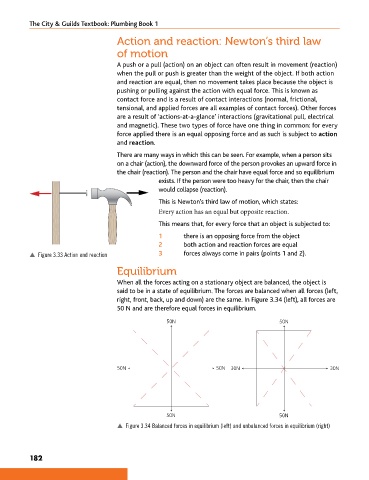
                                            There are many ways in which this can be seen. For example, when a person sits
                                            on a chair (action), the downward force of the person provokes an upward force in
                                            the chair (reaction). The person and the chair have equal force and so equilibrium
                                                                                                 50N
                                                          exists. If the person were too heavy for the chair, then the chair
                                                          would collapse (reaction).
                                                          This is Newton’s third law of motion, which states:
                                                          Every action has an equal but opposite reaction.
                                                                                 50N                             50N
                                                          This means that, for every force that an object is subjected to:
                                                          1       there is an opposing force from the object
                                                          2       both action and reaction forces are equal
                p  Figure 3.33 Action and reaction        3       forces always come in pairs (points 1 and 2).

                                            Equilibrium                                          50N

                                            When all the forces acting on a stationary object are balanced, the object is
                                            said to be in a state of equilibrium. The forces are balanced when all forces (left,
                                            right, front, back, up and down) are the same. In Figure 3.34 (left), all forces are
                                            50 N and are therefore equal forces in equilibrium.

                                                            50N                                  50N


                                            50N                             50N  30N                             30N


                                                            50N                                  50N
                                            p  Figure 3.34 Balanced forces in equilibrium (left) and unbalanced forces in equilibrium (right)


                182

                                                            50N


        9781510416482.indb   182                                                                                    29/03/19   8:55 PM


                                            30N                             30N


                                                            50N

