


Page 131 - APPLIED PROCESS DESIGN FOR CHEMICAL AND PETROCHEMICAL PLANTS, Volume 1, 3rd Edition
P. 131
Fluid Flow                                           115

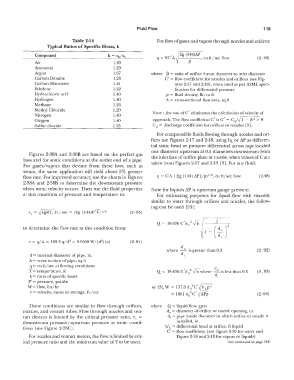
                               Table 2-14                          For flow of  gases and vapors through nozzles and orifices:
                     Typical Ratios of Specific Heats, k
                Compound                      k  = <;,/  Cv  __  �                                           (2-48)
                Air                              1.40
                Ammonia                          1.29
                Argon                            1.67            where  �  =  ratio of orifice throat diameter to inlet diameter
                Carbon Dioxide                   1.28                 C' = flow coefficient for nozzles and orifices  (see Fig-
                Carbon Monoxide                  1.41                     ures 2-17 and 2-18), when used as per ASME  speci-
                Ethylene                         1.22                     fication for differential  pressure
                Hydrochloric  acid               1.40                  p  = fluid density,  lb/  cu ft
                Hydrogen                         1.40                  A = cross-sectional flow area, sq ft
                Methane                          1.26
                Methyl  Chloride                 1.20            Note: .jhe use ofC'  eliminates the calculation of  velocity of
                Nitrogen                         1.40
                                                                                                            4
                Oxygen                           1.40            approach. The flow coefficient  C'  is C' =   Cd/ �   1  - �  > 'f/
                Sulfur dioxide                   1.25            Cd  =  discharge coefficient for orifices or nozzles  [3].
                                                                   For compressible fluids flowing through nozzles and ori-
                                                                 fices use Figures 2-17 and 2-18,  using hL or f1P as differen-
                                                                 tial  static  head or pressure  differential  across  taps  located
                                                                 one diameter upstream at 0.5 diameters downstream from
             Figures  2-38A and  2-388 are  based on  the perfect gas   the inlet face of  orifice plate or nozzle, when values of  Care
           laws  and for sonic conditions at the outlet end of a pipe.   taken from Figures 2-17 and 2-18 [3]. For any fluid:
           For  gases/vapors  that  deviate  from  these  laws,  such  as
           steam,  the  same  application will  yield  about 5%  greater
                                                                                        1
           flow rate. For improved accuracy,  use the charts in Figures   q  =  C'A  ([2g  (144)  l1P]/p) 1 2,  cu ft/sec flow   (2-48)
           2-38A and  2-38B  to  determine  the  downstream  pressure
           when sonic velocity occurs. Then use  the fluid properties   Note for liquids f1P is upstream gauge pressure.
           at this condition of pressure and temperature in:       For  estimating  purposes  for  liquid  flow  with  viscosity
                                                                 similar to water through  orifices  and  nozzles,  the follow-
                                                                 ing can be used  [53]:
             v,  =  � kgRT,  ft/sec=  (kg  (144)P'V)l/ 2   (2-85)

                                                                   Q =  19.636 c'  d / .i;  /----
           to determine the flow rate at this condition from:                              (  : �
                                                                                     �         I
                                                                                       1
             v  =  q/A  =  183.3q/d 2  =  0.0509W/(d 2 )(p)   (2-91)
                                                                             do
                                                                       where  -  is greater than 0.3         (2- 92)
             d =  internal diameter of pipe,  in.                            d
             A= cross section of pipe,  sq ft
             q =  cu ft/sec  at flowing-  conditions                                       d
                                                                                02
             T =  temperature,  R                                  Q =  19.636 c'  d  {h  where  - is less than 0.3   (2 - 93)
                                                                                              0
              k =  ratio of specific heats                                                 di
             P' =  pressure,  psi abs
                                                                                 02
             W =  flow,  lbs/hr                                  or  [3],  '"'  =   157.6d C' � hLp 2
              v = velocity,  mean or average,  ft./sec                   =  1891  d 0  C  -y l1Pp            (2-94)
                                                                                 2
                                                                                   ,�
             These  conditions  are  similar to  flow  through  orifices,   where  Q =  liquid flow,  gpm
           nozzles, and venturi  tubes. Flow  through nozzles and ven-   d, =  diameter of orifice or nozzle opening,  in.
           turi  devices  is  limited  by  the  critical  pressure  ratio,  re  =   di  =  pipe inside diameter in which  orifice or nozzle is
           downstream  pressure/upstream  pressure  at sonic  condi-       installed, in.
           tions  (see Figure 2-38C).                                  h'  L  =  differential head at orifice, ft liquid
                                                                       C' = flow coefficient (see Figure 2-39 for water and
             For nozzles and venturi meters, the flow is limited by crit-   Figure 2-18 and 2-19 for vapors or liquids)
           ical pressure ratio and the minimum value of Y to be used.                            (text continued on page 118)

