


Page 135 - APPLIED PROCESS DESIGN FOR CHEMICAL AND PETROCHEMICAL PLANTS, Volume 1, 3rd Edition
P. 135
Fluid Flow                                           119

            3. If sonic  velocity  of step  2  is  greater than  calculated   From Figure 2-38, Y = 0.97; from Figure 2-18.
              velocity of step  1, calculate line  pressure drop using
               usual  flow  equations.  If these  velocities  are  equal,
               then  the  pressure drop  calculated will be  the  maxi-   c' (assumed turbulent)             (2-47)
               mum  for  the  line,  using  usual  flow  equations.  If                  [l  -   (dof  a, )-1  ]1;2
               sonic velocity is less than  the velocity of step  1, reas-
               sume line size and repeat calculations.          where Cd  = orifice discharge coefficient,  uncorrected for
                                                                         velocity of approach
          B.  How to determine  flow rate (  capacity) for a given  line size
          and  fixed pressure drop.                               C' =  0.74 at est. Re� 2000
                                                                  Temperature  = 460  +  50  = 510°F
            This is also a trial and error solution following the pat-
          tern of (A),  except capacities  are  assumed  and  the  pres-
          sure  drops  are  calculated  to  find  a  match  for  the  given   D   .   144P   144 (54.7)
          conditions  of inlet  pressure,  calculating  back  from  the   ensity  =  P  =  RT   =   (96.4)  (510)
          outlet pressure.                                               =  0.1602 lb/cu ft

          C.  How to  determine pressure  at inlet  of pipe system for  fixed   W =  1891  Y d/C  (Af>p)1;2   (2-95)
          pipe size and  flow rate.                               W =  1891  (0.97)  (0.750) 2  0.74  [(3)  (0.1602)]112
                                                                  W =  529.2 lbs/hr methane
             1. Determine  sonic  velocity  at  outlet  conditions  and
               check  against a  calculated velocity  using  flow  rate.  If   Check assumed  R.,  to  verify  turbulence;  if not in  rea-
               sonic is the lower,  it must be used as limiting, and capac-   sonable  agreement,  recalculate  C'  and  balance  of solu-
               ity is limited to that corresponding to this velocity.
            2. Using  the lower velocity,  and corresponding capaci-   tion, checking:
               ty,  calculate  pressure  drop  by  the  usual  equations.
               For greater accuracy  start  at the  outlet end  of the   Viscosity of methane = 0.0123 centipoise
               line,  divide  it in  sections  using  the  physical  proper-       =  6.31 W/dµ
               ties of the system at these  points,  backing up  to  the           =  6.31  (502)/  (0.750)  (0.0123)
               inlet end of the line for the friction loss calculations.         Re= 343,373
               This  procedure  is  recommended  particularly  for
               steam turbine and similar  equipment exhausting  to   This  is  turbulent and  satisfactory  for the  assumption.
               atmosphere  or vacuum. The pressure at the inlet of   For helpful  quick reference for discharge  of air through
               the  line  is  then  the  sum  of the  discharge  or outlet   an orifice, see Table 2-12B.
               line  pressure  and  all  the  incremental  section  pres-
               sure losses.  In the case of a turbine,  this would set its   Example 2-11: Sonic Velocity
               outlet  pressure,  which  would  be  higher  than  the
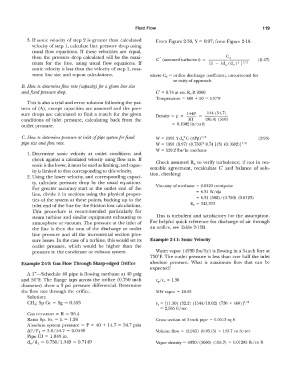
               pressure  in the condenser or exhaust system.      Water vapor ( 4930 lbs/hr)  is flowing in a 3-inch line at
                                                                730°F.  The outlet pressure  is  less  than  one half the  inlet
          Example 2-10: Gas Flow Through Sharp-edged Orifice    absolute  pressure.  What  is  maximum  flow  that  can  be
                                                                expected?
            A  l"-Schedule 40  pipe  is flowing methane at 40  psig
          and  50°F.  The  flange  taps  across  the  orifice  (0.750  inch   s,I  c, =  1.30
          diameter)  show  a  3  psi  pressure  differential.  Determine
          the flow  rate through the orifice.                     MW vapor  =  18.02
            Solution:
            CH 4;  Sp Gr  =  Sg  = 0.553                          v, =  [ ( 1.30)  (32.2)  (1544/18.02)  (730  +  460)] 1
                                                                                                       1 2
                                                                    =  2,065 ft/sec
            Gas constant =  R  = 96.4
            Ratio Sp.  ht.  =  k =  1.26                          Cross section of 3-inch pipe  =  0.0513 sq ft
            Absolute system pressure  =  P =  40  +  14.7  =  54.7 psia
            b.P/P 1  =  3.0/54.7  = 0.0549                        Volume flow =  (2,065)  (0.0513)  =  105.7 cu ft/sec
            Pipe ID  =  1.049 in.
            d /d1  =  0.750/1.049  = 0.7149                       Vapor density= 4930/(3600)  (105.7)  =  0.01295 lb/cu ft
             0

