


Page 138 - APPLIED PROCESS DESIGN FOR CHEMICAL AND PETROCHEMICAL PLANTS, Volume 1, 3rd Edition
P. 138
122                      Applied  Process Design for Chemical and Petrochemical  Plants

                    Complex Pipe Systems Handling Natural          Example 2-14: Looped System
                               (or similar) Gas
                                                                     Determine  the  equivalent length of 25  miles  of 10-in.
               The method suggested in the Bureau of Mines Mono-   (10.136-in.  I.D.) which has a parallel loop of 6 miles of 8-
             graph  No.  6  [ 43)  has  found wide  usage,  and  is outlined   in.  (7.981-in. I.D.)  pipe tied in near the midsection of the
             here using the '\Veymouth Formula as a base.          10-in.  line.
                                                                     Figure  the looped section as  parallel lines with 6 miles
                1. Equivalent lengths of pipe for different diameters
                                                                   of 8-in.  and 6  miles of 10-in. The equivalent diameter for
                                                                   one line with the same carrying capacity is:
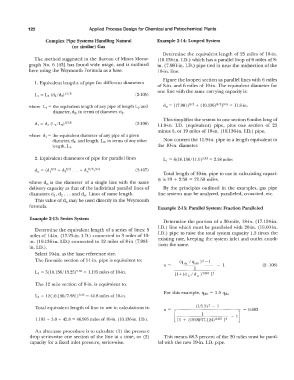
                                                          (2-105)

                                                                      0
             where  L 1  =  the equivalent length of any pipe of length L 2  and   d =  [(7.981) 813  +  (10.136) 813]318  =  11.9-in.
                       diameter,  d2,  in terms of diameter,  d 1.
                                                                     This simplifies the system to one section 6 miles long of
                                                          (2-106)
                                                                   11.9-in.  I.D.  (equivalent)  pipe,  plus  one  section  of  25
                                                                   minus 6, or 19 miles of 10-in.  (10.136-in. I.D.)  pipe.
             where  d 1  = the equivalent diameter of  any pipe of a given
                       diameter,  d2,  and length, L 2,  in  terms of any other   Now convert the  11.9-in.  pipe to a length equivalent to
                       length, L1.                                 the  10-in.  diameter.

                2.  Equivalent diameters of pipe for parallel lines   L1  = 6(10.136/  11.9) 533  = 2.58 miles

                                                          (2-107)
                                                                     Total  length of 10-in.  pipe  to use in calculating capaci-
                                                                   ty is 19 + 2.58  =  21.58 miles.
             where  d.,  is  the  diameter of a  single  line  with  the  same
             delivery capacity as that of the individual  parallel  lines of   By  the  principles  outlined  in  the  examples,  gas  pipe
             diameters dj, d 2  ...  and dn-  Lines of same length.   line systems may be analyzed,  paralleled, cross-tied, etc.
                This value of d.,  may be used directly in the Weymouth
             formula.
                                                                   Example 2-15: Parallel System:  Fraction Paralleled
             Example 2-13:  Series System
                                                                      Determine  the  portion ofa 30-mile,  18-in.  (17.124-in.
                                                                   I.D.)  line which must be  paralleled with  20-in.  (19.00-in.
                Determine  the equivalent length  of a series of lines:  5
             miles of 14-in.  (13.25-in.  l.D.)  connected to 3  miles of 10-   I.D.)  pipe  to  raise  the  total  system capacity  1.5  times  the
             in.  (10.136-in.  I.D.)  connected to  12 miles of 8-in  (7.981-   existing rate,  keeping  the  system  inlet and outlet condi-
             in. I.D.).                                            tions the same.
                Select 10-in. as the base reference size.
                The five-mile section  of 14-in.  pipe is equivalent to:    ( q da  I  q db  )  2   -  1
                                                                      x=  --------- 1                          (2- 108)
                                                                                  1
                L 1  = 5(10.136/13.25) 533  ==  1.195 milesoflO-in.

                The  12 mile section of 8-in.  is equivalent to:
                                                                      For this example, qdb  =  1.5 qda
                L1  ==  12(10.136/7.981) � 3  = 42.8 miles of 10-in.
                                  5·
                Total  equivalent length of line to use in calculations is:        (1/1.5) 2  - 1
                                                                      x=                               =  0.683
                                                                          [     (19.0(VJ\124)2 667   ]
                1.195  +  3.0 +  42.8  =  46.995 miles of 10-in.  (10.136-in.  I.D.).   [1  +   ]2   - 1

                An alternate procedure is to calculate  ( 1)  the pressure
             drop series-wise  one  section  of the line  at a  time,  or  (2)   This means 68.3 percent of the 30 miles must be paral-
             capacity for a fixed inlet pressure,  series-wise.    lel with the new 19-in. I.D.  pipe.

