


Page 137 - APPLIED PROCESS DESIGN FOR CHEMICAL AND PETROCHEMICAL PLANTS, Volume 1, 3rd Edition
P. 137
Fluid Flow                                           121


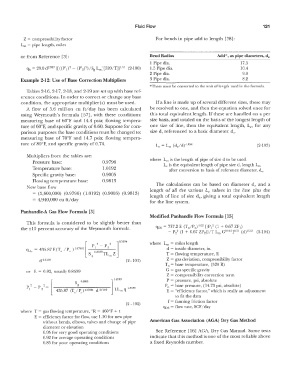
           Z  =  compressibility factor                           For bends in pipe add to  length  [38]:
          Lm  =  pipe length, miles

          or frcm Reference  [3]:                              Bend Radius                 Add", as pipe diameters, de
                                                                1  Pipe dia.                         17.5
                                                                1.5 Pipe dia,                        10.4
                                                               2  Pipe dia.                           9.0
          Example 2-12: Use of Base Correction Multipliers     3 Pipe dia.                            8.2
                                                               *These must be converted to the unit of length  used in the formula.
            Tables 2-16, 2-17, 2-18, and 2-19 are set up with base ref-
          erence conditions.  In order to correct or change any base
          condition, the appropriate multiplier(s)  must be used.   If  a line is made up of  several different sizes,  these may
            A  flow  of 5.6  million  cu  ft/day  has  been  calculated   be resolved to one, and then the equation solved once for
          using  ·weymouth 's  formula  [57], with  these  conditions:   this total  equivalent length.  If these are handled on a  per
          measuring  base  of 60°F  and  14.4  psia;  flowing  tempera-   size basis, and totaled on the basis of the iongest length of
          ture of 60°F,  and specific gravity of  0.60.  Suppose for com-   one  size  of line,  then  the  equivalent length,  Le,  for any
          parison purposes the base conditions must be changed to:   size d,  referenced to a basic  diameter,  de.
          measuring  base  of 70°F  and  14. 7  psia;  flowing  tempera-
          ture of80°F,  and specific gravity of0.74.                                                        (2-103)

            Multipliers from  the tables are:
               Pressure base:               0.9796             where  Lm  is the length of pipe of size d  to be used.
                                                                     Le is the equivalent length of pipe size cl, length  Lm
              Temperature  base:            1.0192                     after conversion to basis of reference diameter,  d.,
               Specific gravity base:       0.9005
              Flowing temperature base:     0.9813
            New base flow                                         The  calculations  can  be  based  on  diameter de  and  a
               =  (5,600,000)  (0.9796)  ( 1.0192)  (0.9005)  (0.9813)   length  of all  the  various  Le  values  in  the  line  plus  the
                                                               length  of line  of size  de,  giving  a  total  equivalent length
               =  4,940,000 cu ft/day                          for the line system.
          Panhandle-A Gas Flow Formula [3]
                                                               Modified Panhandle Flow Formula [15]
            This  formula  is  considered  to  be  slightly  better  than
                                                                               0
          the ±10 percent accuracy of the Weymouth  formula.      %s  =  737.2 E  (T /P 0) 102   [[P/  (1  + 0.67 ZP1)
                                                                       - P22  (1  +  0.67  ZP2)J/T Lm  G0.961]051  (d)253  (2-104)

                               )1.01ss1[         lo.;394       where  Lm  =  miles length
               =                       P/-  P/
            q     435.87E(T  ip                                       d  =  inside diameter,  in.
             d,           S  I   S    s  0.8539TI  z                  T = flowing temperature, R
                                       g      "rn
                 d 2.6182                            (2- 101)         Z  = gas deviation,  compressibility factor
                                                                      T = base temperature,  (520 R)
                                                                       O
            or  E  =  0.92,  usually 0.8539                           G  = gas specific gravity
                                                                      Z  =  compressibility correction term
                                                 13539                P  =  pressure,  psi, absolute
                      [
                                S  0.4606
                   2    435.8_7_(T_,- . 1""" g r_ , _ )               P 0  =  base pressure,  (14.73 psi, absolute)
            P/ - p 2  =             l- . O- i 8_8_-<l-2- . 6- 1 8_ 2 _  l TLm  q   l.B 539   E  =  "efficiency factor," which is really an adjustment
                                          l
                                                                          Lo fit the data
                                                                       f =  fanning friction factor
                                                     (2 - 102)
                                                                     qos  =  flow rate, SCF  I  day
                                       0
          where  T = gas flowing temperature,  R  =  460°F +  t
               E  = efficiency factor for flow,  use  1.00 for new pipe
                   without bends, elbows,  valves and change of pipe   American Gas Association (AGA)  Dry Gas Method
                   diameter or elevation
                   0.95 for very good operating conditions        See Reference  [16]  A.GA,  Dry  Gas  Manual.  Some  tests
                   0.92 for average operating conditions        indicate that this method is one of the most reliable above
                   0.85 for poor operating conditions          a fixed Reynolds number.

