


Page 140 - APPLIED PROCESS DESIGN FOR CHEMICAL AND PETROCHEMICAL PLANTS, Volume 1, 3rd Edition
P. 140
124                      Applied Process Design for Chemical  and Petrochemical  Plants

             Parallel System:  New  Capa<:ity after Paralleling      If two-phase  flow  situations  are  not recognized,  pres-
                                                                   sure  drop problems  may  develop which can  prevent sys-
               Solve this relation, rearranged conveniently to  [ 43):   tems from  operating.  It requires very little percentage of
                                                                   vapor,  generally  above 7%  to 8%, to establish volumes and
                                                                   flow velocities that must be solved by two-phase flow analy-
              "'" �   H-[1-+-(  d- b  ....;):....d-.--)-2- . 66_7_]_ 2   sis.  The discharge flow  through a pressure relief valve on
                                                                   a  process  reactor is  often an  important example  where
                                                                   two-phase flow exists, and must be recognized for its back
                                                                   pressure impact.

                        Two-phase Liquid and Gas Flow
                                                                   Flow Patterns
               The concurrent flow of  liquid and gas in pipe lines has
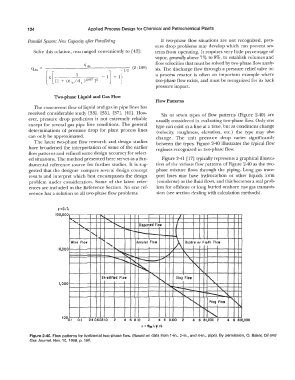
             received  considerable study  [33),  [35],  [37],  [ 41]. How-   Six  or  seven  types  of flow  patterns  (Figure  2-40)  are
             ever,  pressure  drop  prediction  is  not extremely  reliable   usually considered in evaluating two-phase flow.  Only one
             except for several  gas  pipe  line  conditions.  The general   type can exist in a line at a time, but as conditions change
             determinations  of pressure  drop  for  plant process  lines   (velocity,  roughness,  elevation,  etc.)  the  type  may  also
             can only be approximated.                             change.  The  unit  pressure  drop  varies  significantly
                The latest  two-phase  flow research  and design  studies   between the  types.  Figure  2-40 illustrates  the  typical flow
             have broadened the interpretation of some of the earlier   regimes recognized in two-phase flow.
             flow  patterns and refined some design accuracy for select-
             ed situations.  The method presented here serves as a fun-   Figure  2-41  [17]  typically represents a graphical illustra-
             damental  reference  source  for further studies.  It is  sug-   tion of the various flow patterns of Figure  2-40 as the two-
             gested  that the  designer compare several  design  concept   phase  mixture  flows  through  the  piping.  Long  gas  trans-
             results and  interpret which best encompasses  the design   port  lines  may  have  hydrocarbon  or  other  liquids  form
             problem  under consideration.  Some  of the  latest refer-   (condense) as the fluid flows, and this becomes a real prob-
             ences are included in the Reference Section. No one ref-   lem for offshore  or long buried onshore raw gas transmis-
             erence has a solution  to all  two-phase flow problems.   sion (see section dealing with calculation methods).


                          y=G/X
                         100,000                                I   I        I
                               .........    "  ...........                  ,  I
                                 ....
                                   -,             .............   Dispersed  Flow
                                     ..........             ......_
                                       1,  .          -- -  .....          I
                                            :-...
                               Wave  Flow                  Annular  Flow   A   Bubble  or  Froth  Flow
                         10,000               '·   ...........           1  ...
                                                     .... �  �  --     I,.,;   ""  '\..
                                                  ---..... ....  ....   L_.
                                                         ""'""'  �  ..           "  �  �

                                                                 <,                     r-.
                                            Stratified  Flow        i"-..   Slug  Flow
                                                                          �-
                          1,000                                         ....
                                                                              ----
                                                                                              '
                                                                            ............   ""'i---  �  '
                                                                                <,       Plug  Flow   '�
                                                                                   '   n-.            ...
                                                                                             I
                           1000.1   0.2   0.4 0.60.81.0   2   4  6  8  10   2   4  6  8 100   2   4  6  B 1,000  2   4  6  810,000
                                                             x  =  WmXy,/G

              Figure 2-40.  Flow patterns for horizontal  two-phase flow.  (Based on data from  1-in.,  2-in.,  and 4-in.,  pipe).  By permission,  0.  Baker,  Oil and
              Gas Journal,  Nov.  10,  1958,  p.  156.

