


Page 141 - APPLIED PROCESS DESIGN FOR CHEMICAL AND PETROCHEMICAL PLANTS, Volume 1, 3rd Edition
P. 141
Fluid Flow                                           125


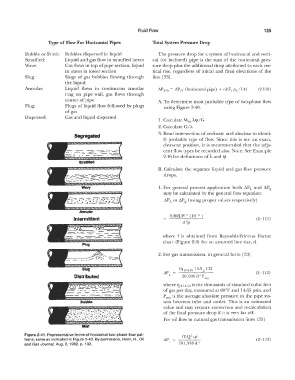
                     Type of Flow For Horizontal Pipes           Total System Pressure Drop

            Bubble or Froth:   Bubbles dispersed in  liquid         The pressure drop for a system of horizontal and verti-
            Stratified:      Liquid and gas flow in stratified layers   cal  (or inclined)  pipe  is  the  sum  of the  horizontal  pres-
            Wave:            Gas flows in top of pipe section,  liquid   sure drop plus the additional  drop attributed to each ver-
                             in waves in lower section           tical  rise,  regardless  of initial  and  final  elevations  of the
            Slug:            Slugs  of gas  bubbles  flowing  through   line  [33].
                             the liquid
            Annular:         Liquid  flows  in  continuous  annular   L'i.PTPh  = L'i.Ppy (horizontal  pipe)  + nhf', PL/144   (2-110)
                             ring  on  pipe  wall,  gas  flows  through
                             center of  pipe                        A.  To determine most probable type of two-phase  flow
            Plug:            Plugs  of liquid flow  followed  by plugs   using Figure  2-40.
                            of  gas
            Dispersed:      Gas and liquid dispersed
                                                                    1. Calculate Wm  A.\jl/G
                                                                    2. Calculate G/t..
                                                                    3. Read intersection of ordinate and abscissa to identi-
                                Segregated
                                                                      fy  probable  type  of flow.  Since  this  is  not an  exact,
                                                                      clear-cut position,  it is  recommended  that  the adja-
                                                                      cent flow types be recorded also. Note:  See Example
                                                                      2-16 for definitions of A.  and 'I'·
                                  Stlatllled
                                                                    B.  Calculate  the  separate  liquid and gas  flow  pressure
                                                                      drops.


                                                                    1. For general  process  application  both  L'i.PL  and  L'i.P  g
                                                                      may be calculated by the general  flow  equation:
                                                                      L'i.PL  or L'i.P  ( using proper values respectively)
                                                                               g

                             �m�                                      where  f is  obtained  from  Reynolds-Friction  Factor
                                                                                2
                                                                         3.36fLW  (l  O -6  )
                                Intermittent
                                                                                                             (2-111)
                                                                              d5p
                                                                      chart (Figure  2-3)  for an assumed line size, d.
                                    Plug
                                --2!:3                              2. For gas  transmission, in general  form  [33]


                                    Slug                                     (q d 14.65  )  LS  g  TZf
                                                                      L'i.P  =                               (2-112)
                                Distributed                             g     20  000 d  5 P  avg
                                                                                '
                                                                                  is the thousands cf standard cubic feet
                                                                      where qd  14 _ 65
                                                                      of  gas per day,  measured at 60°F and 14.65 psia,  and
                                                                      Pavg  is  the average  absolute pressure  in  the pipe sys-
                                                                      tem  between  inlet and outlet.  This  is  an  estimated
                                                                      value and may  require correction and recalculation
                                                                      of the final  pressure drop if it is very far off.
                                                                      For oil flow .in natural  gas  transmission lines  [33]


           Figure 2·41. Representative forms of horizontal two-phase flow pat-   fLQ21,p
           terns; same as indicated !n Figure 2-40. By permission,  Heim,  H., Oil                           (2-113)
           and Gas Journal,  Aug.  2,  1982,  p.132.                         181,916d 5

