


Page 144 - APPLIED PROCESS DESIGN FOR CHEMICAL AND PETROCHEMICAL PLANTS, Volume 1, 3rd Edition
P. 144
128                      Applied Process Design for Chemical and Petrochemical  Plants

               5. Two-phase flow for horizontal  flows:            lent flow,  (b)  sub-atmosphere pressure,  (c)  pressure drop
                                                                   is  limited  to  10%  of the  final  pressure  (see  comment to
                            2
                  LlPTr =  LlPc<I> crr =  (0.0254)  (1.31) 2   =  0.0438 psi/ft   follow),  and  ( d)  the  lower  limit  for  application  of the
                                                                   method is
                6.  Fe= 0.00967  (Wm) 05 /v1'· 7
                    = 0.00967  (19,494)0.5/(2ll)0.7                  W/d  7  20                                (2-125)
                    =  0.032

                  Vertical elevation pressure drop component:      where Wis the flow rate in lbs/hr and d is the inside pipe
                                                                   diameter in inches.  If the above  ratio is less  than  20,  the
                  = n h  fcpdl44  =  [(3)  (10)  +  (])  (50)] (0.032) (63)/144   flow is  "streamlined" and the data does not apply.
                  =  1.125 psi  total                                If the  pressure  drop  is  greater  than  10%  of the  final
                                                                   pressure,  the pipe length can be divided into sections and
                  Total:                                           the  calculations  made for each  section,  maintaining  the
                                                                   same criteria of (c)  and  (d)  above.
                  LlPTPh  =  (0.0438)  (358)  +  1.125
                       =  16.7 psi,  total for pipe line
                                                                   Method [54]
                Because  these  calculations  are  somewhat  uncertain
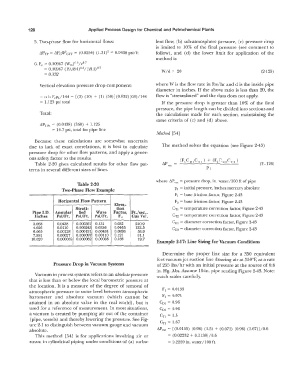
             due  to  lack  of exact correlations,  it is  best  to  calculate   The method solves the equation  (see Figure 2-43)
             pressure drop for other flow patterns,  and apply a gener-
             ous safety factor to the results.
                Table  2-20  gives  calculated  results  for other flow  pat-   LlP vac   (FICDICTI) +  (F2CD2CT2)   (2- 126)
             terns in several different sizes of lines.                                 P1

                                                                   where  LlP,,.c  =  pressure drop,  in. water/100 ft of pipe
                                  Table 2-20
                           Two-Phase Flow Example                          Pt  =  initial pressure,  inches mercury absolute
                                                                           F 1  =  base friction factor,  Figure  2-43
                          Horizontal Flow Pattern                          F 2  =  base friction factor,  Figure 2-43
                                                 Eleva-
                                 Strati-          tion                    Gy, 1  =  temperature correction factor,  Figure 2-43
               Pipe I.D.   Annular   tied   Wave   Factor,  Ft./sec ..
                Inches   Psi/Ft.   Psi/Ft.   Psi/Ft.   F.   Gas Ve!.      � =  temperature correction factor,  Figure 2-43
               3.068     0.0438   0.000367  0.131   0.032   210.9         CD! =  diameter correction factor,  Figure 2-43
               4.026     0.0110   0.000243  0.0336   0.0465   122.5       Cn 2  = diameter correction factor,  Figure 2-43
               6.065     0.00128   0.000131  0.00434   0.0826   53.9
               7.981     0.00027   0.000087  0.00110   0.121   31.1
              10.020     0.000062  0.000062  0.00035   0.166   19.7
                                                                   Example 2-17: Line Sizing for Vacuum Conditions

                                                                      Determine  the  proper  line  size  for  a  350  equivalent
                                                                   feet vacuum jet suction line drawing air at 350°F,  at a rate
                        Pressure Drop in Vacuum Systems            of 255  lbs/hr with an initial  pressure  at the source of 0.6
                                                                   in. Hg. Abs. Assume 10-in. pipe reading Figure 2-43.  Note:
                Vacuum in process systems refers to an absolute pressure   watch scales carefully.
              that is less than or below the local  barometric pressure at
              the location,  It is a measure of the degree  of removal of
              atmospheric pressure  to some level between atmospheric   F1  =  0.0155
              barometer  and  absolute  vacuum  (which  cannot  be    F2  = 0.07l
             attained  in  an  absolute  value  in  the  real  world),  but  is   CDI  =  0.96
              used for a  reference of measurement.  In most situations,   C02  =  0.96
              a vacuum  is  created by  pumping air out of the container   Cn =  1.5
              (pipe, vessels)  and thereby lowering the pressure. See Fig-
              ure 2-1  to distinguish between vacuum gauge and vacuum   � =  1.67
              absolute.                                            LlP,.,.c  =  [(0.0155)  (0.96)  (1.5)  +  (0.071)  (0.96)  (l.67)]/0.6
                This  method  [54]  is  for applications  involving  air  or   =  (0.02232 +  0.1138)/0.6
              steam in cylindrical piping under conditions of (a)  turbu-   =  0.2269 in. water/100 ft.

