


Page 388 - APPLIED PROCESS DESIGN FOR CHEMICAL AND PETROCHEMICAL PLANTS, Volume 1, 3rd Edition
P. 388
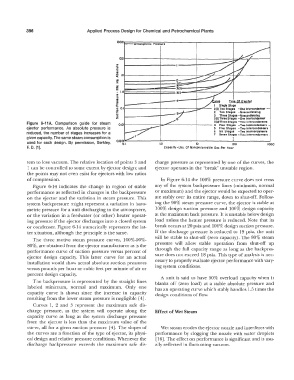
356                       Applied Process Design for Chemical  and Petrochemical  Plants


                                                  IOOOir-- � A � t m_o_s � p h-e � r ic--=P- r e- s s-u- r e-- � ----T---- � --.,-- ����� --,


                                                                                                 lY�iWM
                                                                                           I   Slnvle  stooe   -
                                                                                           2(1) Two Stao11  -One lntercondenser
                                                                                           2  Two  Staoes  -Noncondenslno
                                                                                           3  Three Staoes - Noncondenslno
                                                                           6               3(1) Three Staoes -One lntercondenser
                                                                                           3(2)Three Staoes -Two  lntercondenaere
            Figure  6-11A.  Comparison  guide  for  steam   1---------:l.a.,..,_�-----+----  4  Four Staoes  -Two lntercondensers
            ejector  performance.  As  absolute  pressure  is                              5  Five  Staoes  -Two lntercondensers
            reduced,  the  number of stages increases for a                                6  Six  Staoes  -Two lntercondensers
                                                                                           7  Seven Stoots -Two lntercondensers
            given capacity.  The same steam consumption is
            used  for each  design.  By  permission,  Berkley,      1.0            10             100            1000
            F.  D.  [1].                                              Capacity-Lbs.  Of Noncondcnsable  Gas Per  Hour

            tern  lo lose vacuum.  The relative location of points  3  and   charge pressure  as  represented by one of the curves,  the
            1  can be controlled to some extent by ejector design; and   ejector operates in the "break" unstable region.
            the points may  not even exist for ejectors with  low  ratios
            of compression.                                         In Figure 6-14 the 100%  pressure curve does not cross
               Figure  6-14  indicates  the  change  in  region  of stable   any of the system  backpressure  lines  (minimum,  normal
            performance  as reflected in changes in the backpressure   or maximum) and the ejector would be expected to oper-
            on  the  ejector and  the variation in  steam  pressure.  This   ate stably  over its  entire  range,  down  to  shut-off.  Follow-
            system  backpressure  might represent a variation  in  baro-   ing the 90%  steam  pressure curve,  the ejector is stable at
            metric pressure for a unit discharging to the atmosphere,   100%  design  suction  pressure  and  100%  design  capacity
            or the variation in  a  feedwater  (or other)  heater operat-   al the maximum back pressure.  It is unstable below design
            ing pressure if the  ejector discharges  into a closed system   load  unless  the heater  pressure  is  reduced.  Note  that its
            or condenser.  Figure  6-14 numerically  represents  the lat-   break occurs at 20 psia and 100%  design suction pressure.
             ter situation, although  the principle is the same.   If the  discharge  pressure  is  reduced  to  19 psia,  the  unit
               The  three  motive  steam  pressure  curves,  100%-90%-   will  be stable  to  shut-off (zero  capacity). The 80%  steam
             80%, are obtained from the ejector manufacturer as is the   pressure  will  allow  stable  operation  from  shut-off  up
            performance  curve of suction pressure  versus percent of   through  the  full  capacity  range  as  long  as  the  backpres-
            ejector  design  capacity.  This  latter  curve  for  an  actual   sure does not exceed 18 psia.  This  type of  analysis  is nec-
             installation would show  actual  absolute suction  pressures   essary to properly evaluate ejector performance with vary-
            versus pounds per hour or cubic feet per minute of  air or   ing system conditions.
            percent design capacity.
                                                                    A  unit is  said  to  have  50%  overload  capacity  when  it
               The  backpressure  is  represented  by  the  straight lines   blanks  off  (zero  load)  at a  stable  absolute  pressure  and
             labeled  minimum,  normal  and  maximum.  Only  one   has an  operating curve which stably handles 1.5 times the
             capacity  curve  is  shown  since  the  increase  in  capacity   design conditions of flow.
            resulting from the lower steam pressure is negligible  [ 4].
               Curves  1,  2  and  3  represent  the  maximum  safe  dis-
             charge  pressure,  as  the  system  will  operate  along  the   Effect of Wet Steam
             capacity  curve  as  long  as  the  system  discharge  pressure
            from  the  ejector  is  less  than  the maximum value  of the
             curve,  all for a  given suction  pressure  [ 4]. The  slopes  of   v\Tet steam erodes the ejector nozzle and interferes with
             the curves are a function  of the  type  of ejector,  its  physi-   performance  by  clogging  the  nozzle with water droplets
             cal design and relative pressure conditions. ·whenever the   [16]. The effect on performance is significant and is usu-
             discharge  backpressure  exceeds  the  maximum  safe  dis-   ally reflected in fluctuating vacuum.

