


Page 471 - APPLIED PROCESS DESIGN FOR CHEMICAL AND PETROCHEMICAL PLANTS, Volume 1, 3rd Edition
P. 471
Process Safety and  Pressure-Relieving  Devices                     437

             Before  performing any calculations,  a  thorough  exami-   Sizing Safety Relief Type Devices for Required Flow
           nation of the  possible  causes  and  flow  conditions  of tem-   Area at Time of Relief
           perature  and pressure should be evaluated.  From this list,
           select the most probable and perhaps  the worst case possi-   Before  initiating  any  calculations,  it is  necessary  to
           bility and establish it as a design basis, Figure 7-14.  See [80].   establish  the general  category  of the pressure relief
                                                                   valve  being considered.  This section covers  conven-
             When  the  possibilities  of internal  explosion  or  run-   tional and balanced spring-loaded types.
           away chemical reaction exists, or are even suspected,  they   Given  the  rate  of fluid flow  to  be  relieved,  the usual
           must  also  be  rigorously  examined  and  calculations  per-   procedure  is  to  first  calculate  the  minimum  area
           formed  to  establish  the  magnitude  of the flow,  pressure,   required  in  the  valve  orifice  for  the  conditions  con-
           and  temperature  problems.  Select  the  worst  condition   tained in one of the following equations.  In  the case
           and plan  to provide for its  proper release to  prevent rup-   of steam,  air or water,  the selection of an  orifice may
           ture of equipment.  This latter situation can only  be han-   be made directly from the capacity tables if so desired.
           dled by application of rupture disks  and/ or remote sens-   In either case,  the second step is to select the specif-
           ing and  predetermined rupture  of the disks  (see Figures   ic  type of valve  that meets  the pressure and temper-
           7-5A,  7-8K and 7-8L)  or remote sensing and application of   ature requirements.
           quenching  of the  reaction/  developing  explosive  condi-   General  equations  are  given  first  to  identify  the
           tion  by  automatic  process  action  and/ or  commercial
           application  of quenching  medium.  See  later  discussion   basic terms which correlate with ASME Pressure Ves-
                                                                   sel Code, Section VIII.
           under Explosions.
                                                                   It is  recommended  that  computations  of relieving
                                                                   loads  avoid  cascading  of safety  factors  or  multiple
           Standard Pressure Relief Valves Relief Area Discharge   contingencies  beyond  the reasonable flow required
           Openings                                                Lo  protect the pressure vessel."
                                                                *Extracted by permission from  Teledyne-Farris Engineering Catalog.
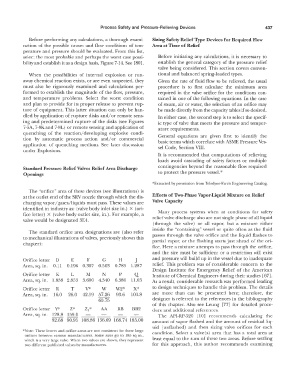
             The "orifice" area of these devices  (see illustrations)  is
           at the outlet end of the SRV nozzle through which the dis-   Effects of Two-Phase Vapor-Liquid Mixture on Relief
           charging vapor/ gases/liquids must pass.  These values are   Valve Capacity
           identified in industry as:  (valve body inlet size in.)  X  (ori-
           fice letter)  X  (valve body outlet size,  in.). For example, a   Many  process  systems  when  at  conditions  for  safety
           valve would be designated 3E4.                       relief valve discharge also are not single phase of all liquid
                                                                 (through  the  valve)  or  all  vapor,  but  a  mixture  either
                                                                inside  the  "containing"  vessel  or quite  often as  the  fluid
             The  standard  orifice  area  designations  are  (also  refer
           to mechanical illustrations of valves,  previously shown this   passes  through  the valve  orifice and  the liquid  flashes  to
           chapter):                                            partial vapor,  or the flashing  starts just ahead  of the  ori-
                                                                fice.  Here a mixture attempts  to pass  through the orifice,
                                                                and  the  size  must be  sufficient  or a  restriction  will  exist
           Orifice letter  D   E     F      G     H      J      and pressure will build up in the vessel  clue to inadequate
           Area,  sq.  in.   0.11  0.196  0.307  0.503  0.785  1.287   relief.  This  problem  was  of considerable  concern to  the
                                                                Design  Institute  for  Emergency  Relief of the  American
           Orifice letter  K   L     M      N      p     Q       Institute of Chemical  Engineers during their studies  [67].
           Area,  sq.  in.  l.838  2.853  3.600  4.340  6.380  11.05   As a result,  considerable research was performed leading
           Orifice ietter  R   T     V*    w     W2*     X*      to  design  techniques  to handle  this problem.  The details
          Area,  sq.  in.   16.0   26.0   42.19  57.26   93.6   101.8   are  more  than  can  be  presented  here;  therefore,  the
                                          60.75                 designer is referred to  the references in  the bibliography
                                                                of this  chapter.  Also  see  Leung  [77]  for detailed  proce-
           Orifice letter  Y*   Z*   Z2*   AA     BB    BB2     dure and additional references.
          Area,  sq.  in.  128.8  159.0   ------                   The  API-RP-520  [10]  recommends  caiculating  the
                       82.68  90.95  108.86  136.69  168.74  185.00   amount of vapor flashed and  the amount of residual  liq-
                                                                uid  (unflashed)  and  then  sizing  valve  orifices  for  each
           *Note:  These  lcuers and orifice areas are  not consistent for these large   condition.  Select a  valve (s)  area  that has  a  total  area  at
           orifices  between  various  manufacturers.  Some  sizes  go  to  185  sq  in.,
           which is  a very large valve.  When  two values are shown,  they represent   least  equal  to  the sum of these  two  areas.  Before settling
           two different published values by manufacturers.     for  this  approach,  this  author  recommends  examining

