


Page 519 - APPLIED PROCESS DESIGN FOR CHEMICAL AND PETROCHEMICAL PLANTS, Volume 1, 3rd Edition
P. 519
Applied Process Design                                     485

            American Society for Testing Materials  (ASTM)  E-502, D-   pressure rise may be a 40-fold increase  [34]. There will be
            56,  D-92,  D-93,  D-1310,  D-3278.                   no  flame  (except possibly  a  "cold flame,"  not examined
              The  flammable  liquid  itself does  not  burn;  only  the   here)  or  explosion  when  the  concentrations  are  outside
            vapors emitted from  the liquid burn. The vaporization of   these flammability limits  [32]. (See Sample listings of  flam-
            a  liquid  depends  on  its  temperature  and  corresponding   mability data Tables 7-20 and 7-21. Also see in Figures 7-45,
            vapor  pressure  and  increases  as  the  temperature  of the   7-46,  and 7-47.  The flammability limits are designated.
            liquid  increases.  Thus,  the  warmer the  liquid,  the  more
            potentially hazardous it becomes.                       1. Lower  Flammability  (Explosive)  Limits (  LEL or IYL): The
                                                                  lowest percentage concentration at which a flash or flame
              Fire point:  The  lowest temperature  at which  a  liquid in   can  develop  and  propagate  from  the  source  of ignition
            an  open container will  give  off enough vapors  to contin-   when in contact with a source of ignition in a combustible
            ue  to  burn when  once  ignited  [32]. This  temperature  is   material.
            generally somewhat above  the open-cup flash point.     2.  Upper Flammability  (Explosive)  Limits.  ( UEL or UFL: The
                                                                  highest  percentage  concentration  at  which  a  flash  or
               Ignition temperature: The minimum temperature to which   flame  can  develop  and  propagate  flame  away  from  the
            a material  must be heated for it to ignite.  Once an ignition   source of ignition when  in  contact with  a source  of igni-
            has occurred it will continue to burn until all  the available   tion  in  a  combustible  material.  See Tables  7-20  and  7-21
            fuel  or oxidant  has  been  consumed  or until  the  flame  is   [34]  for common flammable compounds.
            extinguished by cooling or by some other means  [34].
                                                                    Figure  7-46  illustrates  a  typical  relationship of limits
                                                                  of flammability  and  ignitibility  for a  methane  air  mix-
               Autoignition  temperature:  The  lowest  temperature  of a
            material  required to  initiate  or cause  self-sustained  com-   ture.  Note  that energy  required  to  ignite  a  flammable
            bustion in the absence of a spark or flame.  This tempera-   mixture  (within its  LEL and  UEL)  varies with  the com-
            ture  can vary,  depending  on  the  substance,  its  size,  and   position,  and  that a  0.2  millijoule  (mj)  spark  is  inade-
            the  shape  of the  igniting surface  or container and other   quate  to  ignite even a stoichiometric mixture at atmos-
            factors  [32].                                        pheric pressure at 26°C, while 1-mj spark can ignite any


               Spontaneous  heating:  Some flammable  liquids  combine
            readily  with  oxygen  in  the  air  at  ordinary  temperatures
            and give off heat.  When the heat is generated faster than                          POSITIVE  PHASE
            it can be dissipated,  the temperature rises and ignition or
            the mixture may occur,  as with liquids on waste or rubbish
            or other materials  [32].

              Flammability  limits or explosive mnge: The entire range of
            concentrations of a  mixture of flammable vapor or gas in
            air  (expressed  as  volume  percent)  over which a  flash will   %  +-����__.v_;
            occur or a flame will  travel if the mixture is ignited.  Gases   Po  -  ps-
            and  vapors  in  air have  both  deflagration  and detonation
            limits  and are  often  the  same  as  flammability  limits.  The
                                                                                        t--
            limits of detonability  can  be  different and are  dependent   00'-- ����  ta   � --jf-- ����    -+---
                                                                                              ta+T+
                                                                                                           ta+T++r
            on  the  system  conditions.  Under  some  circumstances  or
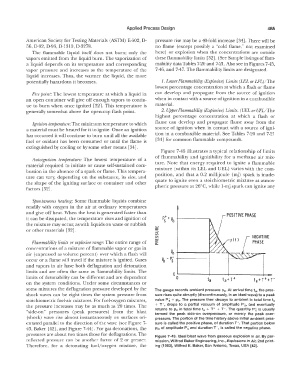
            some mixtures the deflagration pressure developed by the   The gauge records ambient pressure  p0•  At arrival time ta,  the pres-
            shock waves  can  be  eight times  the  system  pressure  from   sure rises quite abruptly (discontinuously,  in an ideal wave) to a peak
            stoichiometric fuel-air mixtures.  For fuel-oxygen mixtures,   value P; +  p0.  The pressure then  decays to ambient in total  time ta
            the  pressure  increases  may  be  as  much  as  20  times.  The   +  T+,  drops  to  a  partial  vacuum  of amplitude  P;,  and  eventually
                                                                  returns  to  Po  in total  time ta  +  T+  +  T-.  The  quantity P�  is usually
            "side-on"  pressures  (peak  pressures)  from  the  blast   termed  the  peak  side-on  overpressure,  or  merely  the  peak  over-
            (shock)  wave  rise  almost instantaneously  on  surfaces  ori-   pressure. The portion of the time history above initial ambient pres-
            entated parallel  to the direction of the wave  (see Figure 7-   sure is called the positive phase,  of duration T+. That portion  below
            43,  Baker [ 42], and Figure 7-44). For gas detonations,  the   p0,  of amplitude P�  and duration T-, is called the negative phase.
            pressures are about two times those for deflagrations.  The   Figure 7-43.  Ideal  blast wave from gaseous explosion  in air.  By per-
            reflected  pressure  can  be  another factor  of 2  or greater.   mission, Wilfred Baker Engineering, Inc., Explosions in Air,  2nd print-
            Therefore,  for  a  detonating  fuel/oxygen  mixture,  the   ing (1983),  Wilfred  E.  Baker,  San Antonio,  Texas,  USA [42).

