


Page 520 - APPLIED PROCESS DESIGN FOR CHEMICAL AND PETROCHEMICAL PLANTS, Volume 1, 3rd Edition
P. 520
486                       Applied Process Design for Chemical  and  Petrochemical  Plants


                                �)                                    �)


                                                                                                 R

                                                                             M'
                                               I
                               (c)                           (d)             I

                                               REGION  OF
                                            /                    M
                                          �-    SUPERSONIC
                                         ·"
                                                   FLOW
                                                                M"


                                          FORMATION  0:
                                          VORTICES               M'
                                                                                    VORTEX  GROWTH

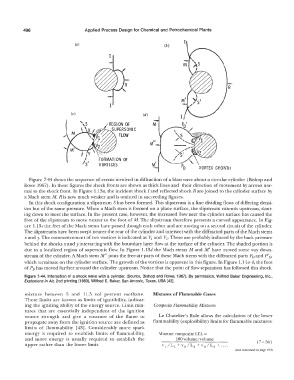
             Figure  7-44 shows the sequence of events involved in diffraction of a blast wave about a circular cylinder (Bishop and
           Rowe 1967). In these figures  the shock fronts are shown as  thick lines and  their direction of movement by arrows nor-
           mal  to  the shock front.  In Figure  l. l 3a,  the incident shock I and reflected shock Rare joined to the cylinder surface by
           a Mach stem M.  R is  now much weaker and is omitted in succeeding figures.
             In this shock configuration a slipstream S has been formed. This slipstream is a line dividing flows  of differing densi-
           ties but of the same pressure. When a Mach stem is formed on a plane surface,  the slipstream extends upstream,  slant-
           ing down  to meet the surface.  In the present case,  however,  the increased flow near the cylinder surface has caused the
           foot of the slipstream  to move nearer to  the foot of M.  The slipstream therefore presents  a curved appearance.  In Fig-
           ure  l. l 3c the feet of the Mach stems have passed though each other and are moving on a second circuit of the cylinder.
           The slipstreams have been swept nearer the rear of the cylinder and intersect with the diffracted parts of the Mach stems
           x and y.  The commencement of two vortices is indicated at V 1  and V 2.  These are  probably induced by the back pressure
           behind the shocks x and y interacting with the boundary layer flow at the surface of the cylinder.  The shaded portion is
           due to  a  localized  region of supersonic flow.  In Figure  l.13d the  Mach  stems  Mand  M' have  moved  some way  down-
           stream of the cylinder.  A Mach stem M"  joins the free-air parts of these Mach stems with the diffracted parts Pn and P'  D,
           which terminate on the cylinder surface. The growth of the vortices is apparent in this figure.  In Figure l. l 4a-b,  the foot
           of Pn has moved further around the cylinder upstream. Notice that the point of flow separation has followed this shock.

           Figure  7-44.  Interaction  of a  shock wave with  a cylinder.  (Source,  Bishop and  Rowe,  1967).  By permission,  Wilfred  Baker Engineering,  Inc.,
           Explosions in Ak,  2nd printing (1983),  Wilfred  E.  Baker,  San Antonio,  Texas,  USA [42].

           mixture  between  6  and  11.5  vol  percent  methane.   Mixtures of Flammable Gases
           These  limits  are  known  as  limits  of ignitibility,  indicat-
           ing the igniting ability of the energy source.  Limit mix-   Composite Flammability  Mixtures
            tures  that  are  essentially  independent of the  ignition
           source  strength  and  give  a  measure  of  the  flame  to   Le Chateliers Rule allows  the calculation  of the lower
           propagate away from the ignition source are defined as   flammability (explosibility)  limits for flammable mixtures:
           limits  of flammability  [ 43].  Considerably  more  spark
            energy  is  required  to  establish  limits  of flammability,   Mixture composite LEL =
            and  more  energy  is  usually  required  to  establish  the   100 volume/volume
           upper rather than  the lower limit.                                                               (7- 54)
                                                                                                    (text continued an page  491)

