


Page 518 - APPLIED PROCESS DESIGN FOR CHEMICAL AND PETROCHEMICAL PLANTS, Volume 1, 3rd Edition
P. 518
484                       Applied Process Design for Chemical and Petrochemical  Plants

           pie,  in a closed vessel,  a hydrocarbon mixture detonation   industry supported program is targeted to understanding
           with air may generate 2.5 times (294 psi)  a similar mixture   the  complexities  of  venting  relief  devices,  particularly
           in a  deflagration.  A deflagration may  turn into a detona-   from runaway reactors.
           tion, especially if  traveling down a long pipe. A shock wave
           is generated by the expansion of  gases created by the reac-
            tion of one flammable gas/liquid with an oxidant, such as   Terminology
            air or pure  oxygen,  or an oxidizing material,  or by  pure
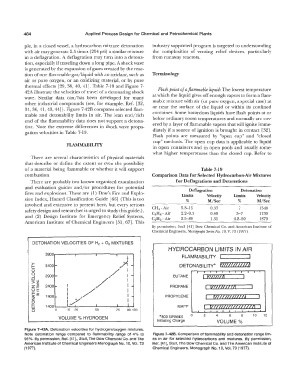
            thermal  effects  [29,  38,  40,  41). Table 7-19 and Figure  7-
           42A illustrate the velocities of travel of  a detonating shock   Flash point of  a  flammable liquid: The lowest temperature
           wave.  Similar  data  can/has  been  developed  for  many   at  which the liquid gives off enough vapors to form a flam-
            other industrial  compounds  (see,  for example,  Ref.  [32,   mable mixture with air (or pure oxygen, a special case)  at
            34,  36,  41, 43, 44)). Figure 7-42B compares selected flam-   or near  the  surface  of the  liquid  or within  its  confined
           mable  and  detonability  limits  in  air.  The  lean  end/rich   container.  Some hazardous  liquids  have flash points at or
            end of the flammability  data does  not support a detona-   below ordinary room temperatures and normally are cov-
            tion.  Note  the extreme differences in shock wave  propa-   ered by a layer of flammable vapors  that will ignite imme-
           gation velocities in Table 7-19.                      diately  if a  source of ignition  is  brought in contact [32).
                                                                 Flash  points  are  measured  by  "open  cup"  and  "closed
                                                                 cup"  methods.  The open cup data is applicable  to  liquid
                             FLAMMABILITY
                                                                 in open  containers and in open pools  and  usually some-
                                                                 what higher temperatures  than  the  closed  cup.  Refer to
              There  are  several  characteristics  of physical  materials
            that describe  or define  the extent or even  the  possibility
            of a  material  being flammable or whether it will  support              Table 7-19
            combustion.                                          Comparison Data for Selected Hydrocarbon-Air Mixtures
              There are probably two known organized examination           for Deflagrarions and Detonations
            and  evaluation  guides  and/or  procedures  for  potential         Deflagration          Detonation
            fires and explosions.  These are  (1)  Dow's Fire and Explo-     Limits     Velocity   Limits    Velocity
            sion Index,  Hazard Classification Guide  [66)  (This is too       %        M/Sec        %       M/Sec
            involved and extensive  to  present here, but every serious
                                                                                                              1540
                                                                                                     ?
            safety design and researcher is urged to study this guide.),   CH 4  -Air   5.3-15   0.37   3-7   1730
                                                                 C3H8 -Air
                                                                             2.2-9.5
                                                                                         0.40
            and  (2)  Design  Institute  for Emergency  Relief Systems,   C2H2 -Air   2.5-80   1.31   4.2-50   1870
           American Institute  of Chemical  Engineers  [51, 67). This
                                                                 By permission,  Stull  [ 41]  Dow Chemical  Co.  and American  Institute  of
                                                                 Chemical Engineers, Monograph Series No.  10,  V.  73  (1977).
               DETONATION  VELOCITIES OF H 2  + 0 2  MIXTURES
                                                                        HYDROCARBON  LIMITS  IN AIR
                    3900r-------T , ----------r,--------,,r--+.--            FLAMMABILITY
                                                      t'"""' _
              >-                                   +.)'¢1                    DETONABILITY*  r11oozom
              I-    3400  -
              0                                /I
              0     2900  .....                        I  -
              ...J
              w.                         /+            I                  BUTANE      I  P1111nA
              s s
                 Q)
              z�    2400,-                             I  -              PROPANE          v111110M
              OE             I        /                I
              �-�
                                    /
              z     1900     1;_;,/                    '  -           PROPYLENE            rllOWWZ!J
              g     1400L---.;J,._ � �·....._   __.1   __. , __  __.1.......,            t1ommzaazzz1
                                                       I
              Cl        0    15   25     50       75   90  100              MAPP
                          VOLUME %  HYDROGEN                        *800  GRAMS   0    2    4    6    8    10   12
                                                                   Initiating Charge        VOLUME%
           Figure  7-42A.  Detonation  velocities for hydrogen/oxygen  mixtures.
           Note  detonation  range  compared  to  flammability  range  of 4%  to   Figure 7-428. Comparison of flammability and detonation range lim-
           95%. By permission, Ref. (41)., Stull, The Dow Chemical Co. and The   its  in  air for selected  hydrocarbons  and  mixtures.  By  permission,
           American Institute of Chemical Engineers Monograph No. 10, Vol. 73   Ref.  (41), Stull, The Dow Chemical Co. and The American Institute of
           (1977).                                               Chemical  Engineers,  Monograph No.  10,  Vol. 73 (1977).

