


Page 531 - APPLIED PROCESS DESIGN FOR CHEMICAL AND PETROCHEMICAL PLANTS, Volume 1, 3rd Edition
P. 531
Applied Process Design                                     497

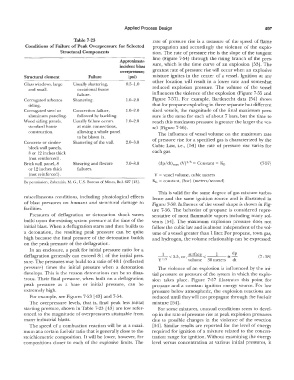
                                Table 7-23                       rate  of pressure  rise  is  a measure  of the  speed  of flame
            Conditions of Failure of Peak Overpressure for Selected   propagation  and  accordingly  the  violence  of the  explo-
                          Structural Components                  sion.  The rate of pressure  rise is  the  slope  of the  tangent
                                                                 line  (Figure 7-54)  through  the  rising branch  of the  pres-
                                                   Approximate
                                                   incident blast   sure,  which  is  the  time  curve  of an  explosion  [53]. The
                                                   overpressure   greatest rate of pressure rise will occur when an  explosive
           Structural element         Failure          (psi)     mixture  ignites  in  the  center of a  vessel.  Ignition  at  any
                   .����--���--��������--.c.__��                 other location  will  result  in  a  lower rate  and  somewhat
           Glass windows, large   Usually shattering,   0.5-1.0
             and small.           occasional frame               reduced  explosion  pressure.  The  volume  of  the  vessel
                                 failure.                        influences  the violence of the explosion  (Figure 7-55 and
           Corrugated asbestos   Shattering.          1.0-2.0    Figure  7-57).  For  example,  Bartknecht  data  [54]  shows
             siding.                                             that for propane exploding in three separate but different
           Corrugated steel or   Connection failure,   1.0-2.0   sized vessels,  the  magnitude  of the  final  maximum  pres-
             aluminum paneling.   followed by buckling.          sure is the same for each of about 7 bars,  but the time  to
           Wood siding panels,   Usually failure occurs   1.0-2.0   reach this maximum pressure is greater the larger the ves-
             standard house      at main connections,            sel  (Figure  7-56).
             construction.       allowing a whole panel            The influence  of vessel volume on  the  maximum rate
                                 to be blown in.
           Concrete or cinder-   Shattering of the wall.   2.0-3.0   of pressure rise for a  specified gas  is characterized by  the
             block wall panels,                                  Cubic  Law,  i.e.,  [54]  the  rate  of pressure  rise  varies  for
             8 or 12 inches thick                                each gas.
             (not reinforced).
           Brick wall panel, 8   Shearing and flexure   7.0-8.0    (dp/dt)ma.,  (V) 113  =Constant= Kc        (7-57)
             or 12 inches thick   failures.
             (not reinforced).                                    V  = vessel volume, cubic meters
           By permission,  Zabetakis,  M.  G., U.S.  Bureau of Mines,  Bui.  627  [ 43].   Kc  =  constant,  (bar)  (meters/second)

                                                                   This is valid for the same degree of gas  mixture  turbu-
           miscellaneous  conditions,  including physiological  effects   lence  and  the  same  ignition  source  and  is  illustrated  in
           of blast  pressures  on  humans  and  structural  damage  to   Figure 7-58.  Influence of the vessel  shape  is shown in Fig-
           facilities.                                           ure  7-56.  The  behavior of propane  is  considered  repre-
              Pressures  of  deflagration  or  detonation  shock  waves   sentative  of most flammable  vapors  including  many  sol-
           build upon  the existing system pressure at the time of the   vents  [54].  The  maximum  explosion  pressure  does  not
           initial blast.  When a deflagration starts and then builds to   follow the cubic law and is almost independent of the vol-
           a  detonation,  the  resulting  peak  pressure  can  be  quite   ume of  a vessel greater than l liter.  For propane, town gas,
           high  because  the  final  pressure  of the  detonation  builds   and hydrogen,  the volume relationship can be expressed:
           on the peak pressure of the deflagration.
             In an  enclosure,  a  peak for initial  pressure  ratio for a
                                                                        <  -  •
                                                                     1
                                                                                                  dp
                                                                                surface  <
           deflagration  generally  can  exceed 8:1  of the initial  pres-   --  .:> • .:>,or,---   =-       (7 - 58)
           sure. The pressures may build to a ratio of 40: l  (reflected   V I/3   volume   30 meters   dt
           pressure)  times  the  initial  pressure  when  a  detonation   The violence  of an  explosion  is  influenced  by  the  ini-
           develops.  This  is  the  reason  detonations can  be so  disas-   tial  pressure or pressure of the system in which the explo-
           trous.  Their final  pressure,  when built on  a  deflagration   sion  takes  place.  Figure  7-57  illustrates  this  point  for
           peak  pressure  as  a  base  or  initial  pressure,  can  be   propane  and  a  constant ignition  energy  source.  For  low
           extremely high.                                       pressure  below  atmospheric,  the  explosion  reactions are
             For example,  see Figures 7-53  [ 43)  and 7-54.    reduced until  they will not propagate through the fuel-air
             The  overpressure  levels,  that is,  final  peak  less  initial   mixture  [54].
           starting pressure,  shown in Table 7-23  [ 43]  are  low  refer-   For some mixtures,  unusual conditions  seem  to devel-
           enced to  the magnitude of overpressures  attainable from   op in the rate of pressure rise at peak explosion pressures
           many industrial  blasts.                              due  to  possible  changes  in  the  violence  of the  reaction
             The speed  of a combustion  reaction will  be at a  maxi-   [54]. Similar results are  reported for the  level  of energy
           mum at a certain fuel-air ratio that is generally close to the   required for ignition  of a mixture  related  to  the concen-
           stoichiometric  composition.  It will be lower,  however,  for   tration range  for ignition. Without examining the energy
           compositions  closer to  each  of the  explosive  limits.  The   level  versus  concentration  at  various  initial  pressures,  it

