


Page 549 - APPLIED PROCESS DESIGN FOR CHEMICAL AND PETROCHEMICAL PLANTS, Volume 1, 3rd Edition
P. 549
Applied Process Design 515
Maximum Pressure During Venting
� I II 11 II
� � I II I II I I I
K s, . bar· m/sec Prod• bar ga
,,-- 50
� I\
� ,1" ... / ,,-- 75 0.3---,.
0.4---,._ \
'' / r--100 0.5--_ \ I\.
'
I\ ' // -,so 0.6-\ I\\
'" ' / V/ /,. -250 o.a-. \. \. -, '\
I\.. '
I\.. .....
/ // -200
... ,
-, ''
,,
'\
"I\.. .......
1.0
" x >,
'' ''
'\ '\ \\
t,,
'"i .,, 400 1.6
'
// /
' ... ' ..... " // / / 300 1.3 \ \ \I\' ., .,
r-., ., , ....... // / / 500 "\. .\. \I\ 'I\
''
''
/,' �
.,,.,
II,
.,f'I.... ,, ... � � I( / / / 2.0�, \.' \.I\ 'l'I.' /_, ,, .,,. ...... �
/ �600
'\
'\
\
'''
'
.,, x, '' ' \ .x,.r,,.,,. .,.,, ....... �
.....
,,,
'l'.."' , , .............. 'lc"°I / \\ \1'1. \ I\'\/., /. /j
\, \
'I\ ...... .........
.,,.,,, -..,., ...
I/
'" " ,, .,. � »:»:
rr .,,.,
_..,.,.,,.
xrx >,
'\
............ /:,..'\ ' ..... ' \ \ \ � "/. V/
... , -,
' ''
,.....
' ' '' � ' ' ,.,,.,.,.,, '/ � ..... _. "//
//
'' ...
...,,.,,,, )
'
''\
' " '
// "// // ... v
..... ,
'
............
/ ,..... ,, .,
. ,, ,, .....
.....
11\"I
............... I'- ' .... .,.., V// :;...,.,,- .,
,....-., .,
,,,
'''' ' " ....
//
' ., ....... " ..... I\.. ' ' / ::;. ., ,,,,.,.,,,
., ,, ,.,
,,
»<>: "/
I\ ... , ...
,.,,.
.......
"''
// '/ / .,.
/
' II, ,I'. ...... x > '' /.,,::;., -.,,.., ;., /'.,, "/
l'\. I\.. .......
, ...
,,,, .,. .,.
'I'- ' '" �/ ., ,, I/
.....
.,['\.. -c ...... //., '/ v
" ' '\
..... ' '' .,,.,.,,,,.,.
.............. "
x x >
'// I/
"'" ...... , ... "/
'" '''
,,
''"
100 10 0.1 10 100 1000
----Vent Area. m 2 Vessel Volume, m 3 ----
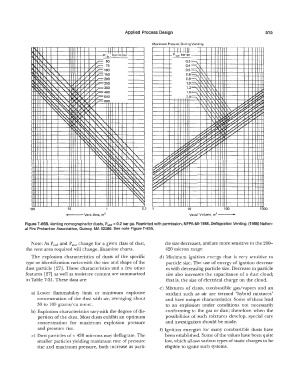
Figure 7-656. Venting nomographs for dusts, P stat = 0.2 bar ga. Reprinted with permission, NFPA 68-1988, Deflagration Venting, (1988) Nation-
al Fire Protection Association, Quincy, MA 02269. See note Figure 7-63A.
Note: As Pred and Ps,.at change for a given class of dust, cle size decreases, and are more sensitive in the 200-
the vent area required will change. Examine charts. 420 micron range.
The explosion characteristics of dusts of the specific d) Minimum ignition energy that is very sensitive to
type or identification varies with the size and shape of the particle size. The use of energy of ignition decreas-
dust particle [27]. These characteristics and a few other es with decreasing particle size. Decrease in particle
features [27] as well as moisture content are summarized size also increases the capacitance of a dust cloud;
in Table 7-31. These data are: that is, the size of electrical charge on the cloud.
e) Mixtures of dusts, combustible gas/vapors and an
a) Lower flammability limit or minimum explosive oxidant such as air are termed "hybrid mixtures"
concentration of the dust with air, averaging about and have unique characteristics. Some of these lead
30 to 100 grams/ cu meter. to an explosion under conditions not necessarily
b) Explosion characteristics vary with the degree of dis- conforming to the gas or dust; therefore, when the
persion of the dust. Most dusts exhibit an optimum possibilities of such mixtures develop, special care
concentration for maximum explosion pressure and investigation should be made.
and pressure rise. f) Ignition energies for many combustible dusts have
c) Dust particles of'< 420 microns may deflagrate. The been established. Some of the values have been quite
smaller particles yielding maximum rate of pressure low, which allows various types of static charges to be
rise and maximum pressure, both increase as parti- eligible to ignite such systems.

