


Page 552 - APPLIED PROCESS DESIGN FOR CHEMICAL AND PETROCHEMICAL PLANTS, Volume 1, 3rd Edition
P. 552
518                       Applied Process Design for Chemical and Petrochemical  Plants

                                                                 Maximum  Pressure  During Venting


                 �
                   l'I
                  �   II..  t\.                                           P,ed• bar ga
                     'I
                 �   [\                                                        0.4  ---..
                  l'I   ...   t\.                                              0.6-1'\.
                   ['-   'r,..,..                                              0.8�  N:[\.                l,i.
                    I\.   r\.
                                                                                     �'\ l'-1'-
                      [\   '                     I                             1.0  -                 );;;;;  t-  I,  i.
                                                                                                           J,,,
                                                                               1.5  -
                        "\  1'.  "  -,   ,  v-  � Dust class St-1              2.0-        rs r  r   /   I;'   l,,i.i.
                                                                                         "'
                                                                                     I:'\ r-,
                                                                                                    '/  �  , .....
                                            Dust class St-2
                          f'\.  �   "'"  ..11/  Ir-  >-Dust class St-3                '\  I'\  ['..  l'r   V/  �  �  L,  I,., �
                             '\  �II  �I<                                                ['..;)   V'l  v  [/
                                  �
                                 �  "\  -,                                             I,,'  ..,..."D   'l/v
                                   �                                               ....... -: �   /
                                                                                       v  ...............
                                      '  '-   '                                        v
                                      '  '\                                     //  �  /��
                                           -,
                                       I'\..  II.."                         �;  "'ll  '/  v
                                                                             ;
                                          I'\.  'I                      /�  .,,  ;   00  /
                                            '\   � l'I   II..       ,;�  -t-  v
                                                 ""  I\
                                                                            ""i.
                                                                            I,  i.
                                                                            I,
                                                �   r....-.....   //  r-  vi.,,  �
                                                                            1�
                                                  �  I'\  '  '  \.   �  � v
                                                                        " I,'
                                                     t\.  '\  �   /"'./". v
                                                       t-,  -,   v
                                                         r\.  '\
                                                           �
               100             10                            0.1                10             100           1000
                                       Vent Area,  m 2
                            -----                                             Vessel  Volume,  m 3-----
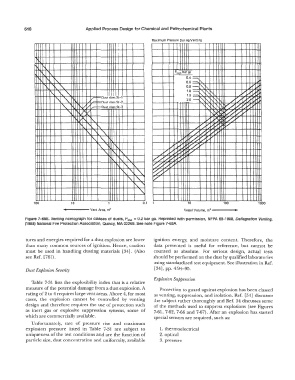
            Figure 7-65E.  Venting  nomograph  for classes of dusts,  Pstat =  0.2  bar ga.  Reprinted  with  permission,  NFPA 68-1988,  Deflagration  Venting,
            (1988)  National  Fire Protection Association,  Quincy,  MA 02269.  See note  Figure 7-63A.
            tures and energies required for a dust explosion are lower   ignition  energy,  and  moisture  content.  Therefore,  the
            than  many  common  sources  of ignition.  Hence,  caution   data  presented  is  useful  for  reference,  but  cannot  be
            must  be  used  in  handling  dusting  materials  [34].  (Also   counted  as  absolute.  For  serious  design,  actual  tests
            see Ref.  [76]).                                      should be performed on the dust by qualified laboratories
                                                                  using standardized test equipment.  See illustration in Ref.
            Dust Explosion. Severity                              (34], pp.  4:94-95.
                                                                  Explosion Suppression
              Table  7-31  lists  the explosibility index  that is a relative
            measure of the potential damage from a dust explosion. A   Protection to guard against explosion has been classed
            rating of 2 to 4 requires large vent areas. Above 4, for most   as venting,  suppression, and isolation.  Ref.  (54]  discusses
            cases,  the  explosion  cannot  be  controlled  by  venting   the subject rather thoroughly and Ref.  34 discusses some
            design  and therefore requires the use of protection such   of the methods used  to  suppress  explosions  (see  Figures
            as  inert  gas  or  explosive  suppression  systems,  some  of   7-61, 7-62,  7-66 and 7-67). After an  explosion  has  started
            which are commercially available.                     special sensors are required,  such as:
              Unfortunately,  rate  of  pressure  rise  and  maximum
            explosion  pressure  listed  in  Table  7-31  are  subject  to   1. thermoelectrical
            uniqueness of the test conditions and are the function of   2. optical
            particle size,  dust concentration and uniformity,  available   3.  pressure

