


Page 547 - APPLIED PROCESS DESIGN FOR CHEMICAL AND PETROCHEMICAL PLANTS, Volume 1, 3rd Edition
P. 547
Applied Process Design                                     513

              • For small  reiief areas,  Pred  >  1  bar,  independent of   for many  specific  dust types,  and  the  same  laws  of flam-
                ignition  energy.  Relief  area  (vent  area,  A)  from   mability apply as were previously presented for flammable
                nomograms  must be  increased  by  a  constant factor,   gases/vapors,  following the "cubic law"  [27]  for explosive
                M ==  0.08V 213.                                  violence  [54]:
              Recommend applying only for methane, propane, and                    113               1
            solvent  vapors due to insufficient data and for a static acti-   (dp/dt)max,Vl  (V1)   =  (dp/dt)ma.x, V2  (V2) 13,   (7-73)
                                                                                     =  Kc  (gases), bar m/sec
            vation pressure of the relief device of  Pstat  �  0.1  bar (see           or K.t  (dust), bar m/sec
            reference  [54]).
              Vessels with internal components may be susceptible to   (dp/dt)pr � d.Vl  (Vi)l/3  =  (dp/dt)pred,V2  (V2)1/3   (7-74)
            turbulence in the gas mixture, which can lead to detona-                  =  (Kc)pred  or (K;,)Pred, bar m/sec
            tions, which are not covered by this procedure.  Hydrogen
            is  particularly  vulnerable  to  detonations;  therefore,  for   when subscript   G =  for gas systems
            such  systems,  a  specialized  expert  should  be  consulted.          st =  for dust system
            The details of NFPA-68 should also be consulted as  there                f =  specific relief area
            are  many factors  that must be recognized.  Also see refer-     (dp/dt)ma.,  =  maximum rate of pressure  rise,
            ence  [34].                                                                 bar/sec
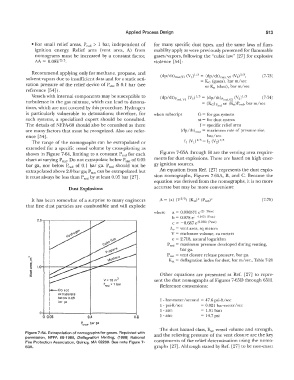
              The  range  of the  nomographs  can  be  extrapolated or        f1  (V;)1;3  =  f2  (V2)1;3
            extended  for a  specific  vessel  volume  by  cross-plotting as
            shown in Figure  7-64,  limiting to  a  constant  Pred  for each   Figures  7-65A through  H are  the venting area require-
            chart at varying  Pstat·  Do not extrapolate below  Pstat of 0.05   ments for dust explosions.  These are based on high ener-
            bar ga,  nor  below  P  red  of 0.1  bar ga.  P  red  should  not be   gy ignition sources.
            extrapolated above 2.0 bar ga;  Pstat can be extrapolated but   An equation from Ref.  [27]  represents the dust explo-
            it must always be less than Pred by at least 0.05 bar [27].   sion  nomographs,  Figures  7-65A,  B,  and  C.  Because  the
                                                                  equation was derived from the nomographs, it is no more
                              Dust Explosions                     accurate but may be more convenient:

              It has been  somewhat of a  surprise  to  many engineers                                         (7-75)
            that fine dust particles are combustible and will  explode
                                                                  where   a  =  0.000571  e<2)  (Pstai)
                 2.0·��-----------------                                 b  =  0.978 e(-0.105)  (Pstat)
                                                                         c  =  -0.687 e(0.226)  (Pstat)
                                                                        Av  = vent area,  sq meters
                                                                         V  =  enclosure volume, cu meters
                                                                         e  =  2.718, natural  logarithm
                                                                       Prcd  =  maximum pressure developed during venting,
                                                                             bar ga.
                                                                       Psi.at= vent closure release pressure, bar ga.
                                                                        K,t  =  deflagration index for dust,  bar m/sec., Table 7-28

                                                                    Other equations  are  presented  in  Ref.  (27]  lo  repre-
                                            V= 10  m3             sent the dust nomographs of Figures 7-650 through 65H.
                                             P,ed  �  1  bar        Reference conversions:
                      f-Do not
                      I   extrapolate
                      I   below 0.05                                I - bar-meter/second= 47.6 psi-ft/sec
                      I   bar ga                                                     =  0.021  bar-meter/sec
                      I                                             l - psi-ft/sec   =  1.01  bars
                                                                    1  - atrn
                  Q   I
                   0  0.'J5           0.4                o.a        1  - atrn        =  1 4. 7 psi
                                   pstat•  bar ga
                                                                    The dust hazard class,  K,;,,  vessel volume and strength,
            Figure 7-64.  Extrapolation of nomographs for gases.  Reprinted with   and the relieving pressure of the vent closure are the key
            pennission,  NFPA  68-1988,  Deflagration  Venting,  (1988)  National
            Fire  Protection  Association,  Quincy,  MA 02269.  See  note  Figure  7-   components of the relief determination using the nomo-
            63A.                                                  graphs  [27]. Although stated by Ref.  [27]  to be non-exact

