


Page 561 - APPLIED PROCESS DESIGN FOR CHEMICAL AND PETROCHEMICAL PLANTS, Volume 1, 3rd Edition
P. 561
Applied Process Design                                     527

                                                             cle  diameter  [ (2)  (inlet  pipe)].  Thus,  the  cross-section
                                                             area of vapor space A. with equivalent diameter S  should
                                           Latu              be at least [ (2)  (ap)]  where  ap  is the cross-sectional area of
                                                             the  inlet pipe  [33]. To  avoid  bubble  burst  slugging,  this
                                                             author suggests that the cross-sectional area of S be calcu-
                                                             lated to have a vapor velocity of less than the entrainment
                                                     EM!
                                                     ll•ra   velocity for a  mist sized  liquid  particle,  or that the vapor
                                                    at.ck
                                      b¥o=•                  area be  approximately one-third  the cross-section area of
                                                             the diameter of the horizontal drum.  For a vertical drum,
                                                             Ref.  [33]  recommends that the vapor disengaging height
                                        K�
                                                             be three feet.
                                                                When vacuum can form in the system  due to condens-
                                                             ing/ cooling hot vapor entering,  the seal drum  liquid vol-
                                                             ume and possibly the seal drum diameter  /length must be
                   ,._.......                                adjusted to maintain a seal when/if the seal fluid is drawn
                                                             up into the inlet piping. A vacuum seal leg should be pro-
        ----- _,.,_,                                         vided on the inlet 1.2 times the expected equivalent vacu-
       Figure 7-69.  Illustration of one of many collection arrangements for   um height in order to maintain a seal.
       process flow and/or relief valve discharge collections to  relieve to   The following design points should be considered:
       one or more plant flare stacks.  By permission,  Livingston,  D.  D.,  Oil
       & Gas Jour., Apr.  28,  1980.                            • Provide liquid low level alarms  to prevent loss of liq-
                                                                 uid  by  evaporation,  entrainment,  leaks,  or failure  of
                                                                 the makeup liquid system.
        12  inches  to  18  inches.  This  would  be  a  segment  (hori-
        zontal  vessel)  of a  circle  (see  Appendix  Table  24).  Ref.   • Use  a  sealing  liquid  that  has  a  relatively  low  vapor
        [33]  recommends that the cross section area of the vapor   pressure, and is not readily  combustible, and will not
        space above the liquid be at least equivalent to that of a cir-   readily  freeze.  Quite  often  glycol  or  mixtures  are


                                             Pipe diameter,  d, ft,
                                             provide vacuum seal
                                             leg where required
                                                                                       Flare
           Make-up
                                                              r
           seal  liquid


                            .,
                           -,---                       s
                            I
                            I
                 Liquid
                 level
                 control
                                                       baffle-

                          Serrated pipe outlet end
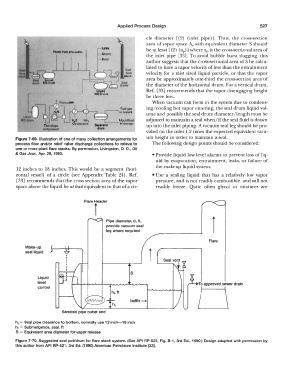
       hL =  Seal  pipe clearance to bottom,  normally use 12 inch-18 inch
       h 1  =  Submergence,  seal, ft
        S  =  Equivalent area diameter for vapor release
       Figure 7-70. Suggested seal  poVdrum for flare stack system.  (See API  RP-521, Fig.  8-1, 3rd  Ed.,  1990.)  Design adapted with  permission  by
       this author from API  RP-521, 3rd Ed. (1990) American  Petroleum Institute (33].

