


Page 565 - APPLIED PROCESS DESIGN FOR CHEMICAL AND PETROCHEMICAL PLANTS, Volume 1, 3rd Edition
P. 565
Applied  Process Design                                    531


                                     Wind---+-
                                                                                             •  I
                                                                                             I
                                                                                             '
                                                                                            It.y
                                                                                             I


                                      +
                                      I
                                      I
                                      I
                                      I
                                       I                           H'            D

                                      H
                                      I
                                      I
                                      I
                                      I
                                      t

                                                                    �----R'----


                                                         ..-------R-----


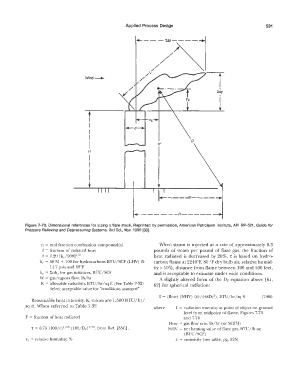
            Figure  7-73.  Dimensional  references for sizing a flare  stack.  Reprinted  by permission, American  Petroleum  Institute,  API  RP-521, Guide  for
            Pressure Relieving and Depressuring Systems,  3rd  Ed.,  Nov.  1990 [33].


                  n  =  mol  fraction combustion compound(s)        When steam  is  injected  at a  rate  of approximately  0.3
                   f =  fraction of radiated heat                 pounds  of steam  per pound  of flare  gas,  the  fraction  of
                   f =  0.20  (hc/900] 11 2                       heat radiated  is  decreased  by  20%.  't is  based  on  hydro-
                  he  =  50 M  +  100 for hydrocarbons BTU/SCF  (LHV)  @   carbon flame at 2240°F,  80 °F dry bulb air,  relative humid-
                      14. 7  psia and 60°F                        ity> 10%, distance from flame between  100 and 500 feet,
                  he  = :Enhc for gas mixtures, BTU/SCF           and is acceptable  to estimate  under wide conditions.
                  W  = gas/vapors flow,  lb/hr                      A  slightly  altered form  of the  Dr equation above  [61,
                  K =  allowable radiation, BTU/hr/sq ft  (See Table 7-32)   62]  for spherical  radiation:
                      Select acceptable value for "conditions assumed"
                                                                    I= (flow)  (NHV)  (E)/(41tDi), BTU/hr/sq ft   (7-86)
              Reasonable heat intensity,  K, values are 1,500 BTU/hr/
            sq ft.  When referred to Table 7-32                   where    1  = radiation iruensity at point of object on ground
                                                                              level from midpoint of flame,  Figures  7-73
            F  =  fraction of heat radiated                                   and 7-74
                                                                        Flow  =  gas flow rate,  lb/hr (or SCFH)
                                      1
              r =  0.79  (100/r) 1 16   (100/DF) 1 16,  from Ref.  [33C].   NI-IV  = net  heating value of flare gas,  BTU/lb or,
                           1
                                                                              (BTU/SCF)
            r 1  =  relative humidity,  %                                  E  =  emissivity  (see table,  pg.  525)

