


Page 104 - Python Data Science Handbook
P. 104
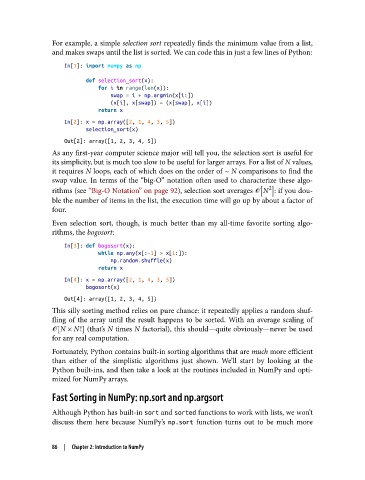
For example, a simple selection sort repeatedly finds the minimum value from a list,
               and makes swaps until the list is sorted. We can code this in just a few lines of Python:

                   In[1]: import numpy as np
                          def selection_sort(x):
                              for i in range(len(x)):
                                  swap = i + np.argmin(x[i:])
                                  (x[i], x[swap]) = (x[swap], x[i])
                              return x
                   In[2]: x = np.array([2, 1, 4, 3, 5])
                          selection_sort(x)
                   Out[2]: array([1, 2, 3, 4, 5])
               As any first-year computer science major will tell you, the selection sort is useful for
               its simplicity, but is much too slow to be useful for larger arrays. For a list of N values,
               it requires N loops, each of which does on the order of ~ N comparisons to find the
               swap value. In terms of the “big-O” notation often used to characterize these algo‐
                                                                           2
               rithms (see “Big-O Notation” on page 92), selection sort averages ᇭ N : if you dou‐
               ble the number of items in the list, the execution time will go up by about a factor of
               four.

               Even selection sort, though, is much better than my all-time favorite sorting algo‐
               rithms, the bogosort:

                   In[3]: def bogosort(x):
                              while np.any(x[:-1] > x[1:]):
                                  np.random.shuffle(x)
                              return x
                   In[4]: x = np.array([2, 1, 4, 3, 5])
                          bogosort(x)
                   Out[4]: array([1, 2, 3, 4, 5])
               This silly sorting method relies on pure chance: it repeatedly applies a random shuf‐
               fling of the array until the result happens to be sorted. With an average scaling of
               ᇭ N × N!  (that’s N times N factorial), this should—quite obviously—never be used
               for any real computation.

               Fortunately, Python contains built-in sorting algorithms that are much more efficient
               than either of the simplistic algorithms just shown. We’ll start by looking at the
               Python built-ins, and then take a look at the routines included in NumPy and opti‐
               mized for NumPy arrays.

               Fast Sorting in NumPy: np.sort and np.argsort

               Although Python has built-in sort and sorted functions to work with lists, we won’t
               discuss them here because NumPy’s np.sort  function turns out to be much more


               86  |  Chapter 2: Introduction to NumPy

